November 26, 2025

How Of the Devil Does the "Dark Age of the Law" Better Than Ace Attorney 5: Dual Destinies

Ah, yes. My continued “play of the Devil” propaganda posting.

I want to put a disclaimer at the beginning here for the “Ace Attorney 5” (AA5) fans in the chat: I don’t hate AA5. I have a lot of qualms in AA6 in particular, but I think with time, I’ve come to terms with some of the aspects I disliked in AA5 and ultimately decided that it’s not as bad as I initially thought.

However, you and I both know that the way they handled the “dark age of the law” concept in AA5 could’ve been handled so much better. It’s like a mystical concept that is nothing more than a jester in a wolf’s costume, dancing around like it means anything more than it does because what do you mean it’s the dark age of the law now? HOW is this different from previous games?

But, I digress. I will try not to spoil any of the events in of the Devil for those interested in checking the game out after reading this, however, I will spoil many events of the Ace Attorney series as a whole, as it’s hard to talk about the plot of the 5th game without understanding the plot of every game prior, including and not limited to Ace Attorney 1 through 5 and Ace Attorney Investigations 1 and 2. If you haven’t played any of these games and want to remain oblivious, I suggest skipping this post.

What is Of the Devil?

Let’s start simple. I’m sure if you’re coming here as an Ace Attorney fan, you might not even know what of the Devil is (or maybe you’re more locked in than me). Of the Devil (also stylistically written “of the Devil”) is an up and coming visual novel, point-and-click adventure game in a similar vein to Ace Attorney, where you play as a defense lawyer trying to get your clients acquitted. It’s set 60 years in the future, where all crimes are recorded and the culprit is easily found and jailed accordingly.

Of course, when all culprits are easily caught, what purpose does a defense lawyer serve? When a string of murders committed with an old-fashioned pistol occurs, the first serial killer in generations is born named the Heartbreak Killer. No one knows how to handle this information, and fear is elevated in the public. The player, playing as the killer defense attorney Morgan, must acquit a man accused of the murder of his girlfriend and the accusation of being the Heartbreak Killer.

There’s only two episodes out as of this post, with a third episode releasing on December 18th, 2025, so it’s a great time to get into the series right now, if you’re interested (and if you’re an Ace Attorney fan, you should be interested). The entire first episode, Episode 0, is free to play right now. So, what are you doing here? Get playing!

Of the Devil’s Dark Age of the Law

Now, of course, in such a setting, it’s easy to see how law and legal proceedings have entered a “dark age” so to say. Out of obligation, an individual’s right to a lawyer still exists, though most defense attorneys in this world don’t really find defending their clients—fighting tooth and nail for their acquittal—fully necessary. Many simple trials in court are overseen by android judges and are quick to come to a verdict.

In many fashions, this future of court proceedings seems very realistic. Nth Circle Studios does a phenomenal job crafting a futuristic world that doesn’t feel far off from our own, and in many ways, expresses the high stake nature of defending a client in such a world.

One of the ways such high stakes are expressed in of the Devil is through the gambling mechanics of the game. For starters, there’s many opportunities in the game to garner credibility, visually expressed through “credits” you achieve through various conversations, articles, and exploration. This credit system functions as a point system, and if you don’t have enough points by the time trial rolls around, you won’t be able to properly acquit your client.

You can lose credits if you make the wrong push in a statement or gamble on the wrong points to bring up in a cross examination, thus creating a situation where you’re gambling your credibility as a lawyer. Ante up on a point you think is right, and it ends up being wrong, and you could lose up to 10 points of credibility, and no longer be able to continue the trial. This mechanic is crucial to the game, occurring in various manners throughout the entire game, and expresses the “dark age of the law” that the world in of the Devil experiences.

On top of this, the story’s plot is crucial to of the Devil’s “dark age of the law” as well, contextualizing the gambling mechanic of the game and the general air of corruption in the legal system. Like I said above, of the Devil’s story surrounds a concept of a corrupt legal system, in which having a lawyer virtually doesn’t matter because your every waking moment is recorded, or accessible by a camera in some capacity. Not only that, but even the weaponry purchasable in such a state is tagged and can be easily connected to the culprit when shot. This dystopian society claims that it helps keep the streets safe by being able to watch a crime happen and convict the correct criminal nine times out of ten, but what happens ten percent of the time when a person is convicted of a crime they didn’t commit?

That’s the question that of the Devil seeks to answer. It’s ingrained in every question of morality in the game, every conversation you have, and the game fundamentally wouldn’t make sense if this corrupt system was not put into place.

Comparatively, “Ace Attorney 5: Dual Destinies” barely creates a realistic or high stakes world for such a “dark age of the law.”

AA5’s Dark Age of the Law

Over the course of AA5, players are introduced to the idea of the world of Ace Attorney being in the throes of a “dark age of the law.” Supposedly, the “dark age” started after Phoenix Wright presented fabricated evidence to the court at the beginning of the seven year gap, losing his badge in the process.

This “dark age of the law” consisted of the time period of 2020 to 2027, where lawyers and prosecutors no longer cared about finding the “truth” of the crime committed, and rather sought out winning by any means necessary, which included fabricating evidence and resulted in many false charges.

The Flaws of AA5’s Dark Age of the Law

If you’ve ever played AA5, hell, if you’ve ever played the trilogy, you should know exactly what I’m about to say. How is the period after Phoenix lost his badge considered a “dark age” when winning by any means necessary was Von Karma’s entire shtick in the first Ace Attorney game?

I cannot stress this enough: the “dark age of the law” that AA5 claims to have begun at the beginning of the seven year gap—after Simon Blackquill was falsely proven guilty of murdering Metis Cykes—has been the state of affairs in the Ace Attorney world for many, many years prior to this event.

Hell, if you’ve played the Ace Attorney Investigations duology, you should be more than aware of the fact that the “dark age of the law” where trials only occur for three days and lawyers are dedicated to winning by any means necessary started after the events of IS-7! Which is bonkers to me because Ace Attorney Investigations was written before AA5, and written by the same writer! Why did that writer essentially retcon his own writing only two years after writing it? I truly don’t think we’ll ever fully understand.

By creating this new “dark age of the law,” the plot of AA5 manages to make its own “dark age” essentially pointless. It makes everything we know about the Ace Attorney judicial system up until this point unnecessary, creating Phoenix this messiah of justice when in actuality, Phoenix Wright was a defense attorney for a measly three years. What does this “dark age” matter if the judicial system has been like this canonically for 20 years up until this point? How did Blaise Debeste, or whatever his name is in the official English release, gain control of the Prosecutorial Committee? How did Von Karma manage to have a 40 year reign of perfectly won cases? How did Gant manage to become the Chief of Police?

Do you think they did it legally? NO! Then what the F!CK is AA5 talking about when it claims that the “dark age” only began after UR-1? (censoring because I’m not sure if Substack likes swear words). And the worst part? You still have to understand the plot of Ace Attorney 1-4 to understand how we got here, which is exactly what the developers of AA5 wanted to avoid!

I cannot stress this enough: the insistence on calling the seven year gap in AA5 the “dark age of the law” not only makes the plot of AA5 annoyingly stupid, but retcons the existence of a “dark age” prior to AA5. If you’ve played any of the previous Ace Attorney games before AA5, the entire plot of AA5’s “dark age” is nothing more than a long-winded, overused joke. Which, frankly, I don’t think is very fair to the plot of AA5! The plot of AA5 is such a unique story with such interesting characters that have such intense backstories on par with the main trilogy cast. It’s a story that hasn’t really been appreciated by the fandom in the last few years. Yet, it is so incredibly unfortunate that its story is bogged down by annoying attempts to make AA5 a game you can play separate from the rest of the series.

Should You Play Of the Devil?

Yes, plain and simple, regardless of who you are, but especially if you’re an Ace Attorney fan. If you liked AA5 and what it was trying to convey with the “dark age of the law” and a corrupt legal system, I definitely think you should give of the Devil a chance. I think it handles the corruption much better than AA5, and makes it much more integral to the plot of the game. If you disliked AA5 or found the “dark age” annoying, then obviously try of the Devil out.

I think it’s definitely worth trying out the free case to see what it’s about, especially if you are interested in the game but want to wait until it’s fully released. It gives a great insight into how the game will play going forward, and leaves enough room for you to question how the plot will progress from that point onward. And, it’s free. Can’t go wrong with that.


And that’s it! Thanks for reading my simultaneous review on of the Devil and rant on why I struggle to like AA5. Lemme know your thoughts on the manner in the comments to this post, I’m super open to other opinions on AA5. Maybe you can convince me to rate AA5 higher.

And I know I’ve been mostly game posting lately, but I’ll have more book/writing posts coming up soon. Very hard to come up with opinions on books that people haven’t already said comparatively. Plus, if you’re coming from my Bluesky or Tumblr, I pretty much only post about games there as well, so I feel like my audience gets it.

Next week should be an update on how Nano went for me (can you believe it’s almost December already?). Into December proper, I’ll have another post on Ace Attorney, specifically the community and its silly holidays, so stay tuned for that.

And, as always, see you next week!

November 19, 2025

Metroid Prime 2: An Unexpectedly Bad But Good Game

I’ve spent the better part of the last two years catching up on most of the Metroid games I can. It’s a game series I can confidently say is one of my favorites, despite it being so vastly different from the other game series I enjoy. Having played all of the 2D games through various means, it was only a matter of time until I started the Prime sub-series.

At one time, I had the first “Metroid Prime” for GameCube. However, the controls for that game are some of the worst controls imaginable. Generation 6 in gaming (a topic I will delve further into at some point) is such a funny time in history because you have the PS2 and Xbox, both of which figured out dual-stick controls for 3D environments within the generation, but then you also have the GameCube which had absolutely no idea what it was doing in a 3D space. You would think that the yellow C-stick would refer to “Camera-Stick,” but much like the Nintendo Switch 2’s mysterious C-button, it isn’t ever what you expect or want out of Nintendo.

If you aren’t aware, the way in which you control the camera in “Metroid Prime” for GameCube is with the analog stick, and aiming outside of it requires you to hold the R shoulder button, then aim. Essentially, you can’t move and aim at the same time. Now, experienced Metroid fans will tell you that this control scheme is perfect for the game because there’s a lock-on for a reason. However, I’m going to tell you that this control scheme sucks and is not worth anyone’s time.

So, once I sold “Metroid Prime” for “Metroid Prime Remastered,” and completed that game without any qualms, the question for how I would get through “Metroid Prime 2: Echoes” became a concern. I definitely didn’t want to be stuck using the shitty GameCube controls, and as of now, there isn’t a re-release on Switch 2. The only other way to play “Metroid Prime 2” is with Wii-mote controls on the “Metroid Prime Trilogy.” And let me be the first to say, yikes.

The Pros of “Prime 2”

Now, I want to start with some of the pros of Prime 2, because I do really enjoy what Prime 2 had to bring to the Metroid series. As a Metroid game, it stands out along with titles like “Metroid Dread” and “Fusion,” with eerie atmosphere and world-building.

While I may have my gripes, I can’t deny that these aspects of “Prime 2” are phenomenally done, and genuinely can be breathtaking at times.

World-Building and Atmosphere in “Prime 2”

One thing that the Prime games continue to be good at is the world-building. The narrative design hidden in scanning the environment and the creatures you run into, along with the tidbits of historical information, continue to be done in such a flawless manner. The subtly of world-building is something that Prime excels at, especially when you enter an area and see a bunch of corpses scattered about, and can only wonder what took them out.

A lot of the time, the world-building is told solely through scans. It incentivizes you to scan the entire area to achieve more lore, specifically with certain doors and messages locked to a particular translation that Samus can’t read without the correct modules in place. These translation modules can incentivize you to continue on, much like the other upgrades within the game, as without them, you can’t explore the entire world. Along with that, oftentimes, you won’t immediately know how to attack a boss until you scan it, which requires quick thinking on your feet to avoid attacks while the scan visor loads. While in the scan visor, you can’t lock on to the enemy to dodge out of the way, so you might have to account for losing a bit of health during the scan sequence.

While the world-building in this game is phenomenal, the atmosphere in Prime 2 is show-stopping comparatively. One thing in particular that continued to impress me was how, in the cut-scene where you save the game, Samus noticeably slumps her shoulders forward, as though the weight of the dread that follows her throughout the game is finally relieved in a moment of reprise at a save station. Deliberate narrative design choices like this help not only with expressing the air of dread and tension within the game, but also help bring the world and characters within it alive. The stress you feel exploring Dark Aether, and the relief when you return to Light Aether aren’t feelings you experience alone, because the player character—Samus—also feels that tension.

There are a lot of aspects of Dark Aether that made the atmosphere so incredibly tense. For one, the entire world is much darker than Light Aether, so traversing around has to be intentional or else you’ll run into one of the many types of Ings unprepared. The air itself is poisonous as well, so each step has to be deliberate or else you will die. There are deceased Luminoth—native creatures of Aether—bodies scattered about that, when you scan them, will tell you that they died to the toxic air in the atmosphere. As such, the atmosphere and world-building work together flawlessly to express such dread and tension while playing.

The Intricacies of the Light World versus the Dark World

Another thing I really liked about Metroid Prime 2 is the general aesthetics of each area of the Light World and how the Dark World played off of that. There are four major areas of Light Aether: Temple Grounds, Agon Wastes, Torvus Bog, and Sanctuary Fortress. Out of these areas, it was really only Agon Wastes and Torvus Bog that felt kind of similar to areas in Prime 1, like Agon Wastes felt very similar to Prime 1’s Temple Grounds on Tallon IV and Torvus Bog felt very similar to the watery areas of Prime 1, yet were quite distinct enough that I never felt like I was walking in the same areas I already had been before.

One thing to keep in mind about Metroid games, particularly the Prime games, is that the planets you explore often tend to have a much more rustic and historical feel to them, like the areas and mechanisms within the different areas will often look dilapidated and worn down, as though no one had lived on the planet in centuries. This world-building aspects makes it incredibly easy to forget that Metroid, as a series, is a sci-fi series (despite the fact that Samus is wearing an advanced space suit and travels around in a gunship). I think it is this reason why Sanctuary Fortress completely shocked me when I first arrived, and is one of my favorite areas in a Metroid game thus far.

Sanctuary Fortress is the last area of the game, and so if you don’t want to be spoiled about the specifics of the area, I would recommend skipping to the section entitled “General Game-Play Loop.” I’m not going to be super spoilery on boss fights and upgrades obtained, but if you want to go in completely blind, then you’re free to skip.

Alright, for those who’ve stuck around, Sanctuary Fortress is essentially this high-tech fortress that the Luminoth created as a last line of defense against any intruders. Essentially, it’s a bunker. There are machine guns posted outside the doors to prevent anyone from entering the area and all of the enemies in this area are essentially robots. There’s even an enemy called the Rezbit, which is essentially a computer virus that frantically attacks you on a protection protocol, and has an attack that will completely shut down Samus’ suit, forcing you to input a code to reset. As annoying as Rezbits are, they are truly one of the most interesting enemies to fight in Prime 2 as a whole. I absolutely love games that have sequences that visually affect the screen, like I’m incredibly fond of Nier: Automata for the exact same reason.

Sanctuary Fortress is such a vastly different vibe from the rest of the areas, almost on par with the vast difference between the E.M.M.I. rooms in Dread compared the rest of the map, except Sanctuary Fortress has so many more enemies that help set the area apart from the rest of the areas in the game.

Comparatively, Dark Aether takes the mirrored versions of these areas on the planet, renaming them to make more sense to the Ing that rule over the area. For example, instead of Sanctuary Fortress, Dark Aether’s mirrored version of that area is called Ing Hive, which functions very similarly to a fortress as a centralized hub. Many of the Dark Aether versions of Agon Wastes and Torvus Bog are renamed similarly, mostly to further the tense and dreadful tone of Dark Aether compared to Light Aether.

General Game-Play Loop

Finally, the general game-play loop of Prime 2 is one of the best within the series. There’s a bit more direction and intention in Prime 2 compared to Prime 1, where you have to obtain the three Dark Temple Keys in each area, unlock the Dark Temple, usually defeat a boss, and take the energy from the Energy controller to return to the Light Temple where it belongs. It’s a simple goal to achieve throughout the game, giving you a bit of direction when in the Dark World, instead of just expecting you to explore and find the upgrades on your own.

I also felt like the Dark Temple Keys helped with the world-building within the game, because the goal of returning the energy to Light Aether is to be able to help the last surviving Luminoth from the horde of Ing in Dark Aether, and eventually destroy the Dark World. You, as Samus, are actively exploring the Dark Aether to achieve these keys in order to save Light Aether from ceasing to exist, and in doing so, the Ing are attacking you because they also don’t want to cease to exist. It helps give the game purpose and meaning outside of just being another game with Space Pirates and Ridley as the enemy, which worked for Prime 1 but of course can’t be the main enemies for every game in the series (or else it’d be boring). And while Space Pirates and Metroids are present within the game, they function as side enemies for the most part, secluded to only a small section of Temple Grounds.

I found that I would forget the main goal of the game being to collect the Dark Temple Keys while exploring, as exploring continues to be the priority of Metroid games, but one thing I did like about the Temple Keys is the size and placement of them. The Temple Keys were roughly the size of Samus, so they were never easy to miss, and on top of that, they were consistently placed in areas where, if you entered the room, your eyes would be immediately drawn to the key. While it wasn’t always obvious in how to obtain the key, it was still placed in a way so that you never truly forgot about collecting them while exploring.

This loop of opening a new area, exploring and collecting the Dark Temple Keys, gathering upgrades along the way to defeat the final boss of the area, only to be granted a new upgrade to explore more of the area and open a new area, was quite enjoyable, and gave a twist to the usual formula of a Metroid game in a way that didn’t feel too demanding or annoying. Literally, a situation where you stumble upon the Dark Temple Keys and are like, “Right, I forgot about that,” collect it and continue exploring in the way that you were previously exploring. Unimposing, I guess, would be the best way to describe it, and yet it surprisingly fits well into the Metroid formula without making the game feel overwhelmingly linear.

The Cons of “Prime 2”

While that’s all fine and dandy, there are aspects of the above sections that are mind-numbingly annoying that a lot of that atmosphere is forgotten. Like, genuinely, some of the most annoying mechanics and level design choices that still irritate me a month after finishing the game.

These are general things I’ve found annoy me about Prime 2 that are exclusive to Prime 2 (as far as I’m aware).

Save Stations and Ammo Refill Stations

My first gripe with Prime 2 is the placement of save stations and ammo refill stations. Within the four areas of Prime 2, there’s only around two save stations per area, which is pretty paltry, to say the least.

I think the work around here is that the save stations are the same in Dark Aether, so technically each area has four save stations, but I don’t consider Dark Agon Wastes and Light Agon Wastes to be the same area, and I don’t even think the game itself considers the Light and Dark World versions of areas to be the same.

With limited save stations, you end up saving in the same spots over and over again, making it challenging to remember where you planned on going when you return to the game. If you return to the game, and the save station is exactly the same one you started in last time you played, a lot of the nuance of exploration and figuring out where to go gets diminished. The amount of times I saved in the exact same save station in Light Sanctuary Temple toward the end of the game man…yikes.

And since the save stations are so spread out, I found myself rushing to the closest save station after any major boss fight just so I didn’t accidentally die and end up having to do the boss fight all over again. I missed a lot of exploration in that manner (which I talked about in my previous post, hint hint wink wink).

Not only that, but there are even less ammo refill stations. There is only one ammo refill station in each area, which isn’t too different from any other Metroid game, but the refill stations are only in inconvenient places in Dark Aether. And maybe that’s not super shocking, because I don’t know about you, but I’m never super pressed to refill my missiles or power bombs. But that’s the problem: it’s not just missiles that need to be refilled.

In Metroid Prime 2, there’s two other beams you can get in the game: light beam and dark beam (and a secret third beam that uses the power of both light and dark). These are limited like the missiles, and you only get fifty shots with either beam when you first get them. And if you play the Prime games at all like I do, you shoot as freely as you can to survive. Keeping track of how much ammo I have of light or dark beam was dreadful and annoying to say the least.

Also, if you want to go to Dark Aether to recharge, you have to use a dark beam to enter the portal. And while there is a fail-safe just in case you run out of ammo for entering portals, I still think that’s a massive fumble on the development team’s part for limiting the ammo and/or having so few ammo refill stations.

Or, if you want to refill in Light Aether, the only location to do so is Samus’ ship. That’s right, you would have to trek your way all the way back to Temple Grounds where Samus’ ship is located, recharge and save while you’re at it, then trek all the way back to where ever the hell you were before.

The Waiting in Dark Aether

Another aggravating thing in Prime 2 is the waiting game you play in Dark Aether. Now, maybe I was the only one that did this, but in Dark Aether, there are little bubbles of light you can sit in and refill your health. These are mainly here to recharge health while trekking through Dark Aether because the atmosphere of Dark Aether is toxic to Samus. You will rapidly lose health if you’re not in a bubble. In the standalone Varia suit, this goes up one point of health for every one second in real life.

And, if you’re anything like me, you cherish any opportunity to receive health.

I found that if there was an area around a portal without any of Dark Aether’s enemies—Ing—I would sit and wait in the bubble until my health was full again before trekking further into Dark Aether or returning to Light Aether. That way, I didn’t have to worry about running out of health as I crept closer to a boss fight.

However, sitting and waiting for your health to go up, point by point, second by second, is so incredibly tedious. And, if you’re health’s really low later in the game, you could sit there for a good 20 minutes.

I ended up getting into calls with my friends to chat while playing Prime 2 because that at least helped the time pass. I would sit my Wii-mote into my lap and have a laugh, while Samus spun around in circles due to the positioning of the Wii-mote when it last saw the sensor bar being at an angle.

Now, obviously, this is more optional than the save station situation. But, I still think it’s a huge nuisance that should be mentioned if someone wants to play Prime 2. You can’t tell me you didn’t sit in those light bubbles for at least a little bit at some point in the game, especially since the crates and containers containing refills gave such paltry amounts of health.

Aggravating Boss Fights

I will state right now, this section will be a bit spoilery, because a lot of the annoying boss fights within this game happen later in the game. So, if you want to go into Metroid Prime 2 as blind as you can, I would skip until the section “Do the Pros Outweigh the Cons?”

I’ll wait until the skippers have skipped.

Have you skipped yet?

Yes? Great. Let’s talk about these boss fights.

There’s a couple of boss fights that really bothered me while playing, and a few aspects of the boss fights that I found quite annoying. For one, the development team introduced these new beams—light, dark, and annihilation—but you didn’t really have to use them in the boss fights. They weren’t required like all of the beams in Prime 1. What made Metroid Prime, the boss fight at the end of Prime 1, so unique to me was the forced usage of all of the beams in order to defeat it. You had to quickly change beams when the color matched that of a particular beam in order to attack. This felt like the accumulation of everything you learned and obtained throughout the game, making for a perfect final boss of a Metroid game.

In Prime 2, the only fight you had to have the light or dark beam for was the Emperor Ing. At that, it wasn’t even needed for every stage, only the very last stage of the final boss. If anything, it felt less like a reward and more like a last-minute requirement. None of the other bosses required the use of dark or light beams, and comparably, super missiles seemed to do an equal amount of damage. At that point, I can only guess why they would decide to limit the dark and light ammo, because it clearly stopped them from requiring the beams used in boss fights.

In the same vein, the Dark Samus 3/4 fight at the end of the game also had no requirement for the dark or light beam. In fact, Dark Samus at this stage can’t be attacked by any other beam other than a charged power beam. Why? Shockingly, I don’t think there’s a reason outside of the fact that this fight happens during the escape, and the developers couldn’t guess whether or not the player would have enough light or dark beam at this point. Instead of using the dark or light beams, this fight requires you to get hit by Dark Samus’ phazon attacks in order to charge up enough phazon to attack Dark Samus with it. For the final boss fight in Metroid Prime 2, it feels like a very lackluster fight, stuck only using the power beam and echo visor without getting to use all of the upgrades you’ve achieved throughout the game.

Fundamentally, because light and dark beams are used so infrequently in the game, the annihilator beam ends up serving absolutely no purpose outside of using it with the echo visor for a couple of puzzles. Puzzles that, by the way, only unlocked a few more missiles and maybe one (1) power bomb upgrade. For all the hype that climaxed into this final achievement, the final beam upgrade, it flops incredibly hard once you achieve it and can’t really use it to its full potential without running out of both dark and light beams.

Now again, I do want to bring up that despite the flaws in the limiting of ammo, some of the boss fights were really cool, specifically the ones that had you fighting against and upgrade. These were intense and challenging, sure, but also done so specifically so that you can see how valuable the upgrade you’re about to achieve is going to be. For all of the anguish the Spider Guardian caused, it was incredibly convenient to be able to traverse that boss fight arena with the spider ball upgrade afterward. It made the challenge worth it, and incentivized continuing on, even when the timing of the Spider Guardian made you want to pull your hair out.

Do the Pros Outweigh the Cons?

I finished Metroid Prime 2: Echoes on October 2nd, 2025, so as of writing this post, it’s been a little over a month. In that time, I have started playing Metroid Prime 3: Corruption in my quest to complete the Prime games before Metroid Prime 4 releases. Now, as a review of just Prime 2, I don’t want my opinions of Prime 3 to sour or enlighten this review (that will be for a review I write up after I finish Prime 3). However, as a sequel game, you kind of have to compare Prime 2 to at least Prime 1. And, to be honest, I think I like Prime 2 better.

Now, when I first finished Prime 2 and experienced the shitshow that was that ending (courteously, I will avoid mentioning specifics for the skippers), I had a lot of negative thoughts initially. A lot of the annoyances that I discussed in the cons section outweighed the pros, and ultimately, the game left a sour taste in my mouth. I was fully convinced that the game I had just played was quite bad comparably, that Prime 1 was much better, and I had concluded that Prime 2 was the worst Metroid game in the series.

That’s kind of harsh for this game, in hindsight. It might not be my favorite Metroid game, but it surely isn’t the worst by far.

Honestly, for whether or not the pros outweigh the cons, that’s a conclusion that only a player can make. If you play through Prime 2 and think it wasn’t that bad, then great! Rate it highly and leave it at that. However, if you have a hard time with getting easily frustrated at a game, I would say watching Prime 2 would be a better experience than playing it. Or hell, wait until a re-release comes out and then give it a shot, because that will likely be a much better experience than playing it on GameCube or Wii.

Compared to the novelty of Prime 1, Prime 2 wasn’t as enjoyable of an experience, to me. But, in hindsight, I think the atmosphere and world-building of the game brings the score of Prime 2 up for me. Ultimately, I would have to say that the pros and cons weigh evenly with this game, so while it is enjoyable, it’s not as enjoyable as Prime 1.

My General Rating for “Metroid Prime 2: Echoes”

In my humblest opinion, and basing my rating on my rating scale in my Google Sheets rant, Metroid Prime 2 is a solid 7/10 game for me. It is an easy game to recommend to people, though with some caveats that it might be a frustrating experience for others. It really truly is an experience that you have to play for yourself to fully know whether or not it’ll be a fun game for you.

I think for that reason, it’s not a 5/10. There’s too many pros that bring the score higher than an averagely rated game, but it can’t be too high because so many of the cons brought me emotional (and at times, physical) pain.


And that’s it! Thanks for reading my first review on this blog! This is the general formatting that I will use for game reviews, with specific sub-categories for each game that I review. My brain wants to write this so much more formally, but I also want to keep this informal, and I feel like that fight is kind of obvious. I’ll keep working with tone for future reviews. I’m also not sure if this exact format would work well for a book review, like pros and cons is not something you look for when you’re reading a book, so I’ll also work that out when I write my first book review (whenever that comes out).

If you have any further opinions about Prime 2, or any suggestions about my reviewing format, please leave a comment on this post!

And as always, see you next week!

November 12, 2025

Why More Games Should Have Save Scumming

 Something I’ve never understood about video game culture is the idea that save scumming, or saving repeatedly and restarting a game when you make a wrong choice or die, is a bad thing. Sure, it might sound like an inauthentic experience where you’re not going through the game blindly, and might even be against the creator’s desired way of playing the game. But, I don’t think it’s that bad of a thing. I don’t even think it’s a cheap tactic to get 100% in a game. I believe it promotes exploration in a way that not a lot of people care to talk about.

Now, I’m not talking about saving your game before a boss fight. This should be an expected practice in all games, and frankly makes for great game design so that if you die, you don’t have to climb your way back to this spot, however long it took to get here. I’m talking about being able to save the game wherever you are, and explore whatever options are given to you.

Save Systems That Irk Me (and why I’ve come to this conclusion)

Certain games have phenomenal save systems, while others have poor excuses of saving systems. Maybe I’ve been burned by playing too many Metroid games over the last year or so, but having a dedicated save spot, where you can only save the game at that location, is one of my least favorite game design aspects ever made. I’ll be honest, I don’t have all day to play games. I think most people don’t. So, forcing a player to sit and play until they get to save the game feels like being chained to the TV. I don’t get to be done playing until the game tells me I can be done.

Don’t get me wrong, I love Metroid. I think “Dread” has the best pacing of save stations in the entire series by far, making it much easier to save and be done with the game on your own terms. But, having recently beat “Metroid Prime 2,” there were many cases where I had to stop exploring and backtrack to wherever the last save station was to save. It was often the first thing I did after a boss fight, which meant missing a lot of hidden upgrades, most infamously the second Dark Temple key in Torvus Bog after defeating the Alpha Blogg (respectively, I’m not going to explain these words. If you know, you know). And in these cases, when I booted up the game in the exact same save station over and over again, I ended up forgetting what I had done previously and where I had explored, which, I feel, defeats the entire purpose of an exploration game.

In these games, I felt pressured to save and stop playing at a save station, to not explore too far without a nearby save station, instead of continuing because I didn’t know how much time I had until the next save station. It could be 30 minutes of gameplay, or an hour and a half. And when you’re just gaming for fun, the stress of not knowing when you’ll get to save next seems unnecessary.

A Not-So-Bad Example of a Save System

Comparatively, I actually kind of like the save systems in a lot of Fire Emblem games. Since I’m currently playing “Path of Radiance” (FE9), I’m going to primarily talk about that system, but for the most part, the system is the same across the board.

In FE9, you can really only save before a battle and once you’ve returned to base camp after a battle. Sounds kinda similar to Metroid’s save stations, right? Well, not really. The only thing that happens between these moments are cut-scenes. You watch a 20-minute cut-scene, then you get to save. Then after the battle, you watch another 10-20 minute cut-scene, and you get to save. Simple! Easy! Not stressful at all!

On the other hand, in battle, you can’t really save whenever you want. There’s a separate save mode implemented for mid-battle saving that’s deleted as soon as you return to the battle (most likely to prevent save scumming). Essentially, you get to save once, return to the title screen, and once you return to the game where you left off, that save is deleted. For a tactical RPG like FE9, this is not a bad system to have, and I also understand why save scumming wouldn’t be ideal. It’d kind of be like save scumming a chess match, like you should probably own up to your mistakes.

For older Fire Emblems like FE9, not having a means of save scumming makes sense. There is no casual mode; if the characters die mid-battle, they’re gone for the rest of the game. Having a means to save scum would defeat the entire purpose of that game mechanic. But for newer Fire Emblems, I don’t see a problem in save scumming if you’re playing casually.

The Best Save System in Gaming

One genre of gaming that I’ve noticed has the best save system implemented is visual novels. Obviously, I mean, why wouldn’t it? The entire game-play is reading a book, and like a book, you can stop and “save” whenever you want. It would be strange if that wasn’t the case.

Now, the visual novel genre also encompasses point-and-click adventures as well. These are, for the most part, the same genre, except there’s more game-play in point-and-clicks than a visual novel. However, like visual novels, point-and-clicks also allow you to save whenever you want (for the most part).

Some examples of this include: Ace Attorney, Zero Escape, Professor Layton, and more recently, of the Devil.

Perceived Cons of Save Scumming

In a lot of these listed games, perceived cons of being able to save whenever you want leads to the question of experiencing the game authentically. Can you really say you experienced “Ace Attorney 3” properly if you save scummed your way through most of the cases?

When the puzzle of the game so heavily depends on game dialogue, like Ace Attorney, it’s hard to justify saving the game and reloading into the game to choose the correct answer. If you make a blunder, choose the wrong answer, or make the wrong argument, it should be expected as a part of the game’s game-play. You solve the puzzle by thinking through the logic of a character’s argument and chipping away at it through cross-examinations. If you save scum through the answer, then the concern becomes whether or not you’re following the logic or puzzle of the game. It’s essentially considered “cheating” the puzzle.

This concern of cheating follows through for most games. If you’re allowed to save scum whenever, then that allows you to cheat through the exploration and follow an “intended path” instead of allowing the game to happen. For Metroid, if you could save scum, there would be less intention to explore and find the upgrades naturally, and instead, always choose the correct path.

However, I don’t think this is a concern for most games. Even in Metroid, save scumming seems mostly pointless because regardless, you still have to explore the map to find the upgrades in one way or another. Getting to save whenever you want doesn’t remove the immersion of the game, and it doesn’t negate basic features of the game-play, like in older Fire Emblems. And in older Fire Emblems, the save system works well-enough so you don’t really need to save mid-battle. If you get to save whenever, you just get to stop playing whenever you want, which should be in the control of the player anyway.

In the case of Ace Attorney, you can save scum whenever you want. Sure, you might not be following the puzzle to a T, or maybe you’re struggling to see how a point of logic connects to another and you want to play down all of your options, but I don’t consider it cheating, and neither should you. Honestly, save scumming lets you explore your options. Maybe it’s the wrong choice, but there’s always unique dialogue you wouldn’t get to see if you only ever made the correct choice. In some cases, there’s even hints as to what the correct answer would be in the wrong answer, so you can realign yourself and reconfigure the positioning of the puzzle.

Or, in the case of Zero Escape, there’s already multiple endings to the game, so save scumming would just save time for later routes to explore your options and see the different endings, rather than having the solve the first puzzle over and over again. In fact, this system encourages save scumming, as when you choose a dialogue option, the next time you play through that scene, the previously chosen option is grayed out. That way, when you return to that point in the game, you know what choices led you to the ending you received.

In these cases, it’s not a matter of perfectionism. It’s seeing what other dialogue occurs when you purposefully choose the wrong option.

What If You Could Choose Not to Save Scum?

One example of exploration in save scumming that I’ve really come to appreciate recently is the save system in of the Devil. Of the Devil is a up-and-coming Ace Attorney-like game where you play as a defense lawyer in the year 2086, defending clients from murders they didn’t commit. However, you’re essentially gambling on each dialogue option you have. It only has two episodes out as of this post (Chapter 0 is free on Steam, by the way), but I can tell from just two episodes that this save system works phenomenally.

In the game, you can save whenever and wherever you want. And frankly, the game really wants you to save as much as you can, because you’re given three pages of nine save spots. Much like other games, save scumming allows you to freely explore your other options and gives hints as to what the correct answer is. However, what makes this game unique is in it’s trials and conversations.

During certain conversations, you might have to dance around a topic to get the information you want out of the character, and choosing the incorrect option would lose you credits, or essentially “credibility points.” If you don’t have enough credits by trial, you might not be able to properly defend your client. These moments play like Blackjack, where certain topics provide higher points, and the goal is to reach 21 points by the end of the conversation. These discussions are great for exploration as it helps show why certain topics are Aces versus others that are only 3 points. Save scumming and seeing where the logic lines up to get 21-points also helps for later conversations about the crime, as you know which topics didn’t work previously.

In trial, there are sequences much like the cross-examination of Ace Attorney where you have to disprove a point the prosecutor made with evidence. You can essentially “Ante-up” certain points of evidence to get more credits, depending on how confident you feel about the solution.

And while all of this is wonderful and makes a lot of the slower parts of an Ace Attorney game much more enjoyable, you can choose not to save scum. That’s right, once you get through Chapter 0, you unlock a mode called the High-roller Mode, where you’re only given one save slot, so every decision counts. It’s a completely optional mode, and you can turn the mode on whenever you want. This, I think, is the best answer to save scumming by far. Not only does of the Devil allow and, frankly, promote save scumming, but gives hardcore players an option to not have the option to save scum. Those players get to play in the means that’s most comfortable for them, giving them the challenge that they desire, while also not making it the default option for those who just want to play the game for fun.

I wish more games did their save systems like Nth Circle Studios did for of the Devil. It makes it so that everyone can play the game how they want, and aren’t tethered to their choices. Players can stop playing whenever they please, explore what other options might bring them, and provide hints to put the player back on track in a way that doesn’t feel demeaning.

Hopefully, this convinced some people that save scumming isn’t the end of the world. Regardless, thank you for reading! Stay tuned next week!

November 5, 2025

Let Me Rant About My Google Sheets For A Moment

 I like tracking things. It’s a part of my life that has stuck with me for a least a decade. Most of my tracking is done through Google Sheets, as it’s simplicity is quite alluring compared to tracking with a physical notebook (especially as a college student).

Tracking the media I consume has made me come to appreciate consuming media much more over the last three years since creating my media consumption spreadsheet. There’s much more purpose behind what I’m watching or reading or playing when I have to write it down in a document, rather than consuming and washing myself of the memory. And, recently, I’ve started jotting down notes on how the piece of media made me feel to remind me why I liked a piece so much when I look back on the list in the future.

I’d like to promote this idea through this post today, while also just kind of rambling in general, as I think more people should get in the habit of consuming media purposefully, instead of this constant train of consumption that is easily forgotten. If we’re going to consume media as a hobby, why don’t we make it a bit fun?

One of the reasons why I started a Substack in the first place was to give myself a proper space to review the games and books that I finish and write up on my trackers. And hopefully, my pointers on my spreadsheets can help you, the reader, come up with ideas on how to start up your own spreadsheet trackers as well.

Now, I’m not gonna sit here and hype up a billion dollar company; I’d actually like to avoid it. Anyone can use Google Sheets as it’s simple and free to use, but if using a notebook sounds tedious, no one should judge using Google Sheets instead. However, if you know an indie spreadsheet company that doesn’t cost money to use, let me know in the comments of this post!

Side note: I’m not an accountant or programmer. I don’t really know what I’m doing; I’m just working with what I know to make Google Sheets enjoyable for me.

The Main Media Completion List

Let’s start with the main media completion list. This is a general list that accumulates all of the media I consume over the course of a full year. Anything from TV Shows to books, are listed here. This spreadsheet is really only one spreadsheet page, as I don’t really need multiple pages to document. Each year gets it’s own spreadsheet, and that’s about it

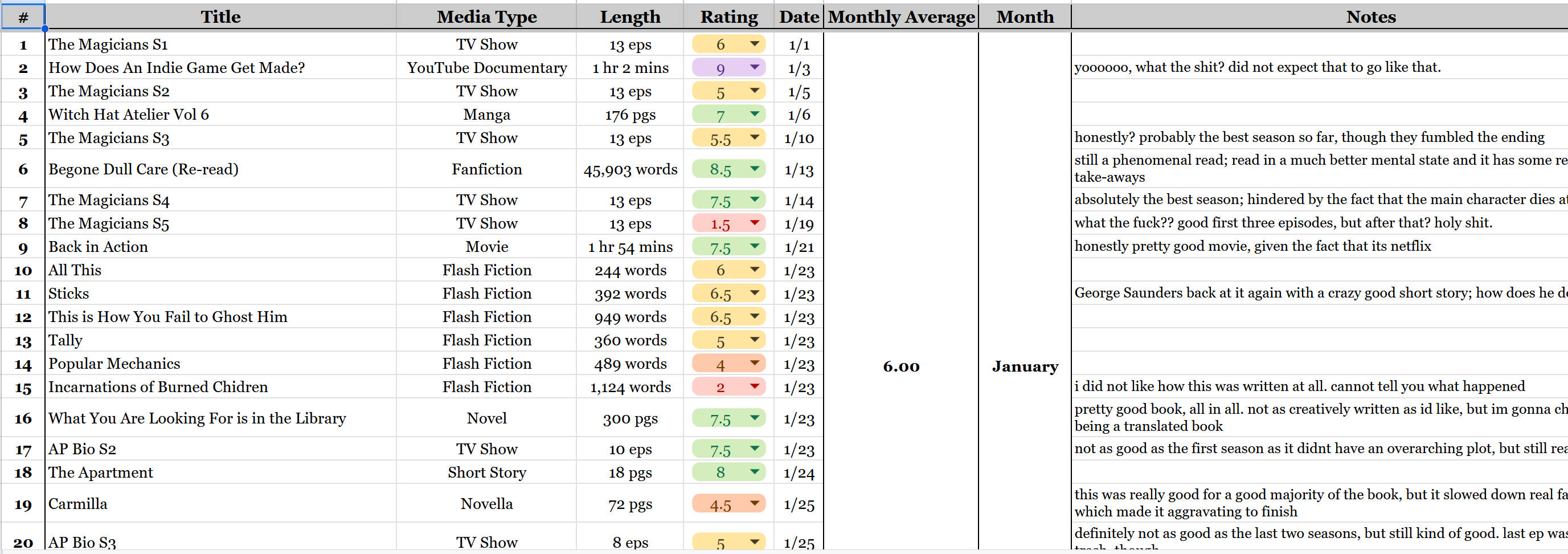
An image of my Media Completion List
My media completion list for the month of January

First up, I list the title of the piece of media. I’ve learned to separate volumes of manga and seasons of shows into individual items on the list, as rating an entire show or manga series can be quite challenging, and oftentimes I won’t get to finish the show in the same month that I spent most of the time watching it. Feels a bit more fulfilling that way. Some seasons are often not accumulative of the show as a whole, as well, like The Magicians Season 5 and AP Bio Season 4 (not-pictured) are some of the worst television I’ve ever seen with my own eyes, yet those shows as a whole aren’t nearly as bad. Makes it a bit more fair to the better seasons as well.

Secondly, I list the media type. This can be as specific as necessary or as vague. For example, flash fiction is vastly different than a novel, or a documentary is vastly different than any other movie. Specifying what the genre is isn’t necessary, but can give a good idea what you spend most of your time consuming.

Thirdly, I list the length of the media. This is also as specific as you need. The length can be how long it took you to complete a game, or the general length of the piece. Might need to do a bit of research on it, if the length is word count over pages.

Fourth, I rate the media. The rating scale I use here is the same across the board for all ratings, as it makes the most sense to me, but it also incredibly vague. It’s 0-10 star rating system, with half stars. I’ll get more specific with it below, but this is the gist of it.

Fifth, Sixth, and Seventh are all related to dates and the like. Fifth is the date I finished the media; sixth is the monthly average of ratings, where the spreadsheet calculates the average rating of everything consumed within the month; and seventh is the month name itself, so when skimming the list, it’s easy to see what month a particular chunk of media was consumed during.

Finally, eighth is where I list out a couple of notes. Most of the time, it’s a simple note describing how I felt about the piece, or left blank to say that the rating says it all. This is a newer addition to my spreadsheet, as it helps me remember why I rated a particular show that rating, instead of depending solely on my memory.

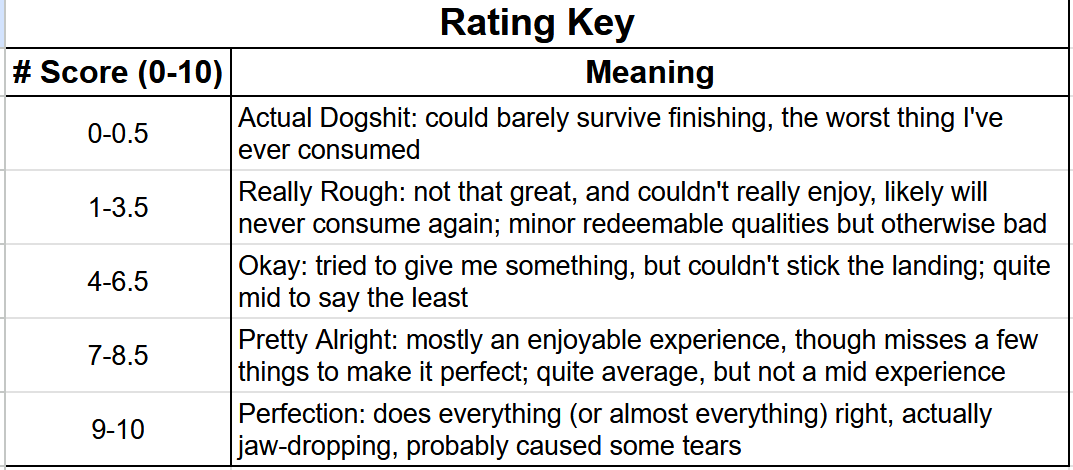
How My Rating System Works

My rating system is pretty self-explanatory, but the gist of it is that a 5/10 is average. Not great, but not particularly bad. Anything lower than that is more bad than good, and a 0-2 out of 10 is really rough, to the point that I wish I didn’t consume it. Higher than a 7/10 is something I’d recommend to a friend, and a 9-10 out of 10 is something that is so good that I’ll be thinking about it for a while, and oftentimes made me have some emotional reaction (like crying).

Everything that is rated is dependent on everything else I’ve previously rated, so if I rate something a 4 versus a 4.5, it’s dependent on something else being personally considered less good than the 4.5. A lot of the time, something is only slightly better than something else, but not a whole star better, so the half stars work well in that regard. Plus, this rating system gives me a lot of space to work with, as I don’t like rating things at the highest rating unless it absolutely deserves that spot. A 5-star rating system with half stars doesn’t give that space, and a 5-star rating system with quarter stars gets too confusing (looking at you, Story Graph).

Rating key for media list; gives reasons for my particular ratings

The Video Game (and subsequently Book) Backlog

This spreadsheet is similar to the media completion list, though it has details to it that are specific to video games in particular, like price or estimated length. This system is used for my book backlog as well, though with it’s own details that are specific to the book, like author.

Since I’d rather this post not get incredibly long, I’m going to stick to my video game backlog in this section, though keep in mind how you could use this set up for a book backlog as well.

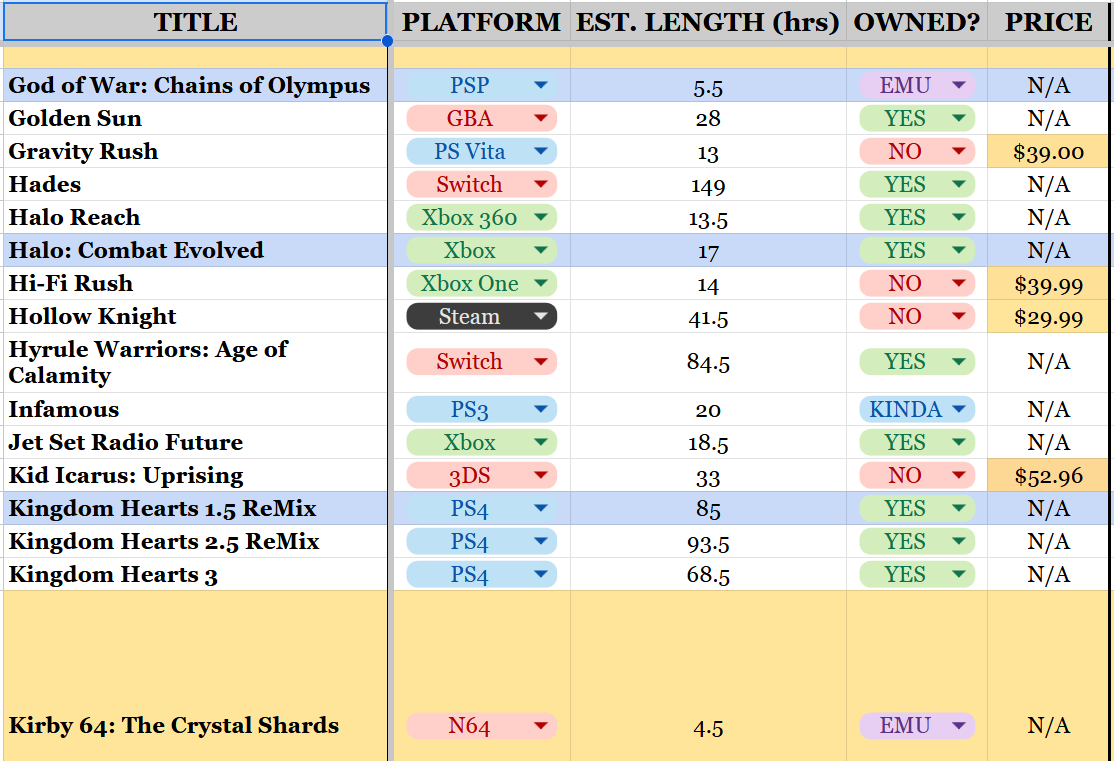
image of video game backlog
The first half of my video game backlog

Now, I’ve only recently figured out a means of using this list without it stressing me out. If anyone’s ever made a backlog and properly tracked how many games they need/want to play, you should know very well the stress of having a backlog. But, luckily, I’ve found a way to list out the games I want to play in a manner that alleviates that stress, and promotes getting to the games when you get to them, rather than prioritizing a list of games.

One thing to keep in mind when making a backlog of any capacity, be it video games, books, or TV shows, is to not put yourself on a schedule. List them out, but list them out alphabetically instead of “most likely to finish” and “least likely to finish.” The backlog is only there to remind you of the games/books you want to finish, not to pressure you to finish them all by the end of the year. Putting yourself on a time limit will force you to push yourself to finish it, like a number on a list rather than a member of a collection, and you might end up hating the game instead of really enjoying the game’s story and environment because it took too long to finish.

The Full List

First up is the full list of my video game backlog, or as full as I can get it as sequels are often left out until I play the first game. This is a list of games I want to play, be it games I own, games I can emulate, or games I want to purchase. I keep the full list of games as the first section of this backlog to show me my options, rather than make me panic about the games I haven’t gotten to yet.

The only games I don’t list on this list are games I don’t consider “completable.” In a sense, these are your racing games, your party games, and your farming sims. Sure, some of these games have an end goal for you to achieve, but for the most part, completing the game isn’t the goal for these types of games, in my eyes. The goal is to have fun, so putting them on a backlog to complete doesn’t seem ideal.

Much like the media completion list, I list out the title of the piece and the format of the game first and foremost. This list is alphabetically ordered so it’s easier to find the exact game I’m looking for (though, games starting with “the” are organized by the second word of the title, not “the.”). Subsequently, “format” in this manner, refers to the platform the game can be found on (e.g. Switch, Steam, PS4, etc.); I have the platform color organized in a drop-down list, where Nintendo consoles are red, PlayStation consoles are blue, and Xbox consoles are green.

Next up, I list out the estimated time to complete each game in hours, based on the average completion time listed on HowLongToBeat.com. Since games don’t have a set-in-stone length like most other mediums of media, the length of how long it will take to complete the game is up to general averages, though can be considerably off from your own completion time, depending on external factors (like exploring for the experience of exploring, rather than jumping from main event to main event).

Thirdly, I list out whether or not I own the game, or whether or not I have to emulate it. If I own the game, then I can easily get started on it whenever I have the time, but if I don’t own the game, I know to essentially block it out of my mind when thinking about the list. This is very helpful for digital and emulated games in particular, as they’re easy to forget that you have it when you don’t physically own it.

Finally, I list the price of the game, if applicable. This is mostly for tracking reasons, so I know how much money it would take to be able to play every game on my list (which is…a depressing number to look at). These numbers are pulled directly from PriceCharting.com, importing the XML data that lists the price, which allows the Google Sheet to update automatically (which is helpful when you’re game hunting in areas with bad WiFi). I have learned, however, that if the price is coming from Steam, the XML data of the regular price from the sale price is separated, so if a game goes on sale, the Google Sheet won’t know where the data went. It’s best to keep those updated with your own research.

And that’s essentially the basic list. There’s a bit of color organization, where gold means I’ve completed the game, teal means I’ve DNF’d the game (for now), and blue means its on my “Up-Next” list, but that’s about it. However, there is a separation on the list for when I’ve completed a game, which is formatted similarly to my media completion list.

How Completed Games Are Tracked

This section essentially slots next to each game in the full list, though can only be edited once the game is complete. Ideally, once you’ve hit the credits in a game, you can return to the Google Sheet to write down how it went.

Examples of a completed review and a DNF’d review (mostly spoiler-free)

Firstly, I write down how I consider the game to be complete. Usually, the completion status I aim for is “Roll Credits.” Some games have side quests or quests to do post-credits, but I personally believe that if it isn’t apart of the main storyline, it’s not important enough for me to explore (unless it’s a Metroidvania)

I then write down the time played and platform that I played the game on. The completion time for a game is something I’ve noticed not all games list out, so sometimes it has to be a guesstimate. On the other hand, the platform that the game’s completed on can be as specific as you want. Say you completed a game through Nintendo Switch Online. While it might technically be an N64 game, most likely you completed it with a Pro Controller or Joycons, and thus isn’t the most accurate experience to playing it on an actual N64. Then, in the platform section once the game’s complete, you can say you played it on “Switch via Nintendo Switch Online.”

Next, I give the game a rating, which is much like the rating system on my media completion list, and can be changed with time. Some games might have a rough ending, though it’s not cumulative of the entire experience, but since the ending is the last thing you experience with a game, it can highly affect the rating. Usually, giving the rating a bit of time, or rating it after you write down your notes on the game, can help guide the rating in the right direction.

Lastly, I list out my notes on the game, or essentially how the game went. This can also be as specific as needed, as some games have more intensive stories or gameplay to discuss compared to Pushmo or Super Mario Bros. Most importantly, this is what I intend to write some of these Substack posts about.

I enjoy writing up my opinions on the games I’ve recently completed, and getting in-depth about why I like or dislike them helps with my memory for later discussions on Tumblr or BlueSky. However, Google Sheets doesn’t really provide enough space to go as in-depth as I’d like, as the length of the comments affects the Google Sheet as a whole. Going forward, whenever I finish a game or book I particularly enjoy, I’ll write up a review and post it here. I’ll try to keep them as unspoilery as possible, and anything that contains spoilers will be marked as such. So, in the coming months, look out for more long-winded reviews!

In Sum… (or TL;DR)

I keep track of a lot of my hobbies, mostly because it provides good brain chemicals when I get to check something off my list, but also because it provides a means of reviewing the content that I consume and analyzing it, rather than it being another check-mark on a list. I use Google Sheets specifically because it’s so much easier to update a Google Sheet than erasing and redrawing in lines for a physical list in a notebook. Plus, it does the math for me. Can’t go wrong with that.

I’m planning on using this Substack as a space where I can properly write out my opinions of the media I’ve consumed (specifically games and books) and review them, hopefully garnering a space of active discussion, instead of a lot of the bashing that happens in other corners of the internet. Everyone’s opinions are valid, everyone’s tastes are different, and no one has the correct opinion on any piece of media because there isn’t one. And that includes me. We’re all our own individual people with our own individual opinions and tastes, and differing from one another is what makes us human.

Anyway, after that long tangent, thank you so much if you’ve read all the way through! And if you skimmed, I don’t blame you, this one was a long one (took me two weeks this time!). Stay tuned next week!

What Consoles Do I Collect For?

And other queries about my game collection and game collecting as a whole.    Ever since writing my “How Emulation Changed My Life” post, I’...