

I like tracking things. It’s a part of my life that has stuck with me for a least a decade. Most of my tracking is done through Google Sheets, as it’s simplicity is quite alluring compared to tracking with a physical notebook (especially as a college student).
Tracking the media I consume has made me come to appreciate consuming media much more over the last three years since creating my media consumption spreadsheet. There’s much more purpose behind what I’m watching or reading or playing when I have to write it down in a document, rather than consuming and washing myself of the memory. And, recently, I’ve started jotting down notes on how the piece of media made me feel to remind me why I liked a piece so much when I look back on the list in the future.
I’d like to promote this idea through this post today, while also just kind of rambling in general, as I think more people should get in the habit of consuming media purposefully, instead of this constant train of consumption that is easily forgotten. If we’re going to consume media as a hobby, why don’t we make it a bit fun?
One of the reasons why I started a Substack in the first place was to give myself a proper space to review the games and books that I finish and write up on my trackers. And hopefully, my pointers on my spreadsheets can help you, the reader, come up with ideas on how to start up your own spreadsheet trackers as well.
Now, I’m not gonna sit here and hype up a billion dollar company; I’d actually like to avoid it. Anyone can use Google Sheets as it’s simple and free to use, but if using a notebook sounds tedious, no one should judge using Google Sheets instead. However, if you know an indie spreadsheet company that doesn’t cost money to use, let me know in the comments of this post!
Side note: I’m not an accountant or programmer. I don’t really know what I’m doing; I’m just working with what I know to make Google Sheets enjoyable for me.
The Main Media Completion List
Let’s start with the main media completion list. This is a general list that accumulates all of the media I consume over the course of a full year. Anything from TV Shows to books, are listed here. This spreadsheet is really only one spreadsheet page, as I don’t really need multiple pages to document. Each year gets it’s own spreadsheet, and that’s about it
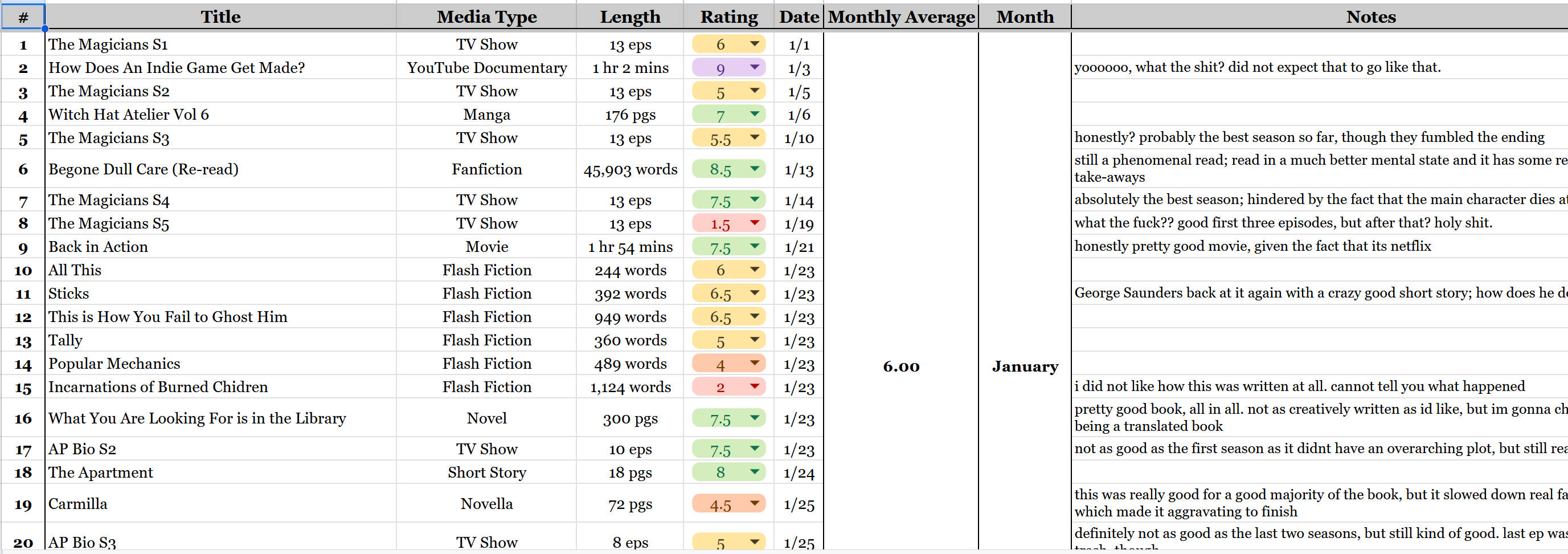
First up, I list the title of the piece of media. I’ve learned to separate volumes of manga and seasons of shows into individual items on the list, as rating an entire show or manga series can be quite challenging, and oftentimes I won’t get to finish the show in the same month that I spent most of the time watching it. Feels a bit more fulfilling that way. Some seasons are often not accumulative of the show as a whole, as well, like The Magicians Season 5 and AP Bio Season 4 (not-pictured) are some of the worst television I’ve ever seen with my own eyes, yet those shows as a whole aren’t nearly as bad. Makes it a bit more fair to the better seasons as well.
Secondly, I list the media type. This can be as specific as necessary or as vague. For example, flash fiction is vastly different than a novel, or a documentary is vastly different than any other movie. Specifying what the genre is isn’t necessary, but can give a good idea what you spend most of your time consuming.
Thirdly, I list the length of the media. This is also as specific as you need. The length can be how long it took you to complete a game, or the general length of the piece. Might need to do a bit of research on it, if the length is word count over pages.
Fourth, I rate the media. The rating scale I use here is the same across the board for all ratings, as it makes the most sense to me, but it also incredibly vague. It’s 0-10 star rating system, with half stars. I’ll get more specific with it below, but this is the gist of it.
Fifth, Sixth, and Seventh are all related to dates and the like. Fifth is the date I finished the media; sixth is the monthly average of ratings, where the spreadsheet calculates the average rating of everything consumed within the month; and seventh is the month name itself, so when skimming the list, it’s easy to see what month a particular chunk of media was consumed during.
Finally, eighth is where I list out a couple of notes. Most of the time, it’s a simple note describing how I felt about the piece, or left blank to say that the rating says it all. This is a newer addition to my spreadsheet, as it helps me remember why I rated a particular show that rating, instead of depending solely on my memory.
How My Rating System Works
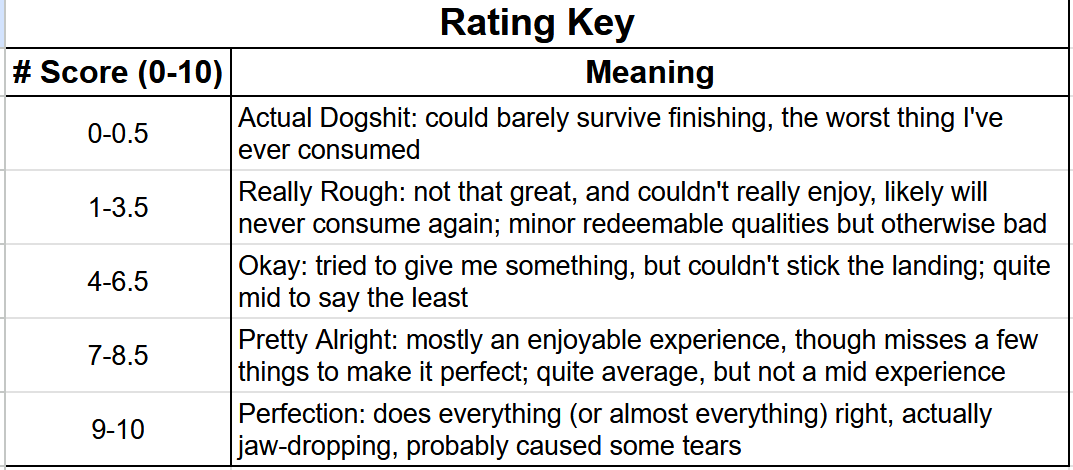
My rating system is pretty self-explanatory, but the gist of it is that a 5/10 is average. Not great, but not particularly bad. Anything lower than that is more bad than good, and a 0-2 out of 10 is really rough, to the point that I wish I didn’t consume it. Higher than a 7/10 is something I’d recommend to a friend, and a 9-10 out of 10 is something that is so good that I’ll be thinking about it for a while, and oftentimes made me have some emotional reaction (like crying).
Everything that is rated is dependent on everything else I’ve previously rated, so if I rate something a 4 versus a 4.5, it’s dependent on something else being personally considered less good than the 4.5. A lot of the time, something is only slightly better than something else, but not a whole star better, so the half stars work well in that regard. Plus, this rating system gives me a lot of space to work with, as I don’t like rating things at the highest rating unless it absolutely deserves that spot. A 5-star rating system with half stars doesn’t give that space, and a 5-star rating system with quarter stars gets too confusing (looking at you, Story Graph).
The Video Game (and subsequently Book) Backlog
This spreadsheet is similar to the media completion list, though it has details to it that are specific to video games in particular, like price or estimated length. This system is used for my book backlog as well, though with it’s own details that are specific to the book, like author.
Since I’d rather this post not get incredibly long, I’m going to stick to my video game backlog in this section, though keep in mind how you could use this set up for a book backlog as well.
Now, I’ve only recently figured out a means of using this list without it stressing me out. If anyone’s ever made a backlog and properly tracked how many games they need/want to play, you should know very well the stress of having a backlog. But, luckily, I’ve found a way to list out the games I want to play in a manner that alleviates that stress, and promotes getting to the games when you get to them, rather than prioritizing a list of games.
One thing to keep in mind when making a backlog of any capacity, be it video games, books, or TV shows, is to not put yourself on a schedule. List them out, but list them out alphabetically instead of “most likely to finish” and “least likely to finish.” The backlog is only there to remind you of the games/books you want to finish, not to pressure you to finish them all by the end of the year. Putting yourself on a time limit will force you to push yourself to finish it, like a number on a list rather than a member of a collection, and you might end up hating the game instead of really enjoying the game’s story and environment because it took too long to finish.
The Full List
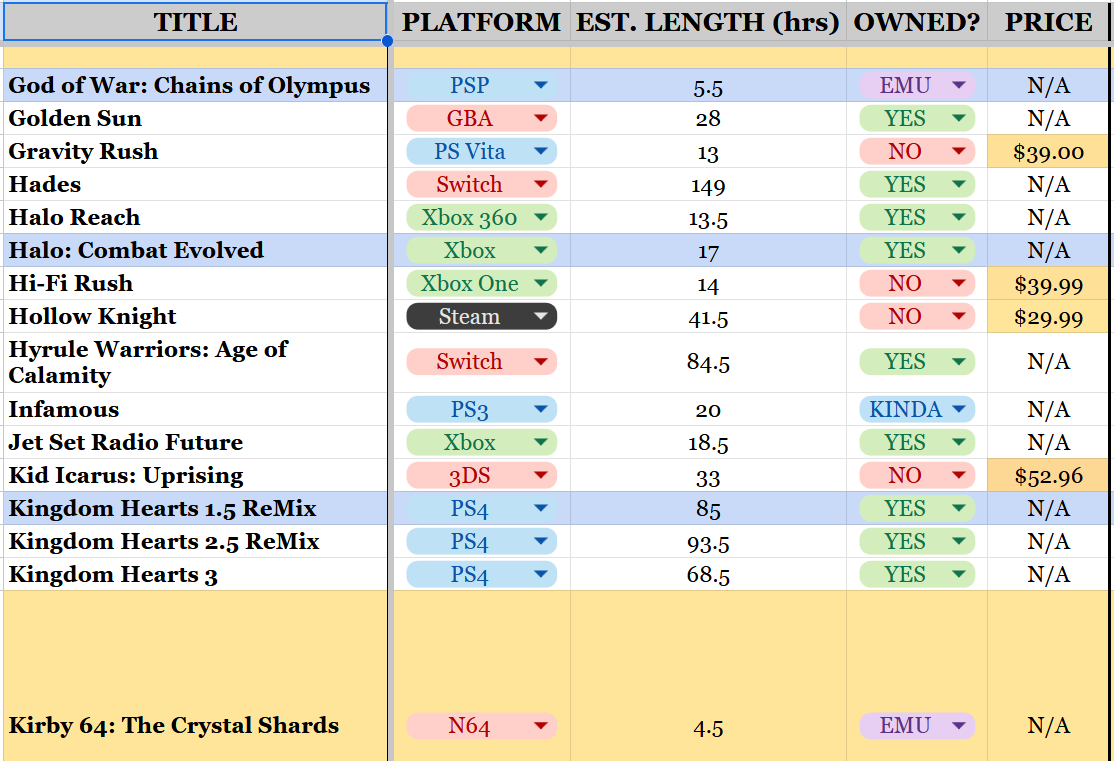
First up is the full list of my video game backlog, or as full as I can get it as sequels are often left out until I play the first game. This is a list of games I want to play, be it games I own, games I can emulate, or games I want to purchase. I keep the full list of games as the first section of this backlog to show me my options, rather than make me panic about the games I haven’t gotten to yet.
The only games I don’t list on this list are games I don’t consider “completable.” In a sense, these are your racing games, your party games, and your farming sims. Sure, some of these games have an end goal for you to achieve, but for the most part, completing the game isn’t the goal for these types of games, in my eyes. The goal is to have fun, so putting them on a backlog to complete doesn’t seem ideal.
Much like the media completion list, I list out the title of the piece and the format of the game first and foremost. This list is alphabetically ordered so it’s easier to find the exact game I’m looking for (though, games starting with “the” are organized by the second word of the title, not “the.”). Subsequently, “format” in this manner, refers to the platform the game can be found on (e.g. Switch, Steam, PS4, etc.); I have the platform color organized in a drop-down list, where Nintendo consoles are red, PlayStation consoles are blue, and Xbox consoles are green.
Next up, I list out the estimated time to complete each game in hours, based on the average completion time listed on HowLongToBeat.com. Since games don’t have a set-in-stone length like most other mediums of media, the length of how long it will take to complete the game is up to general averages, though can be considerably off from your own completion time, depending on external factors (like exploring for the experience of exploring, rather than jumping from main event to main event).
Thirdly, I list out whether or not I own the game, or whether or not I have to emulate it. If I own the game, then I can easily get started on it whenever I have the time, but if I don’t own the game, I know to essentially block it out of my mind when thinking about the list. This is very helpful for digital and emulated games in particular, as they’re easy to forget that you have it when you don’t physically own it.
Finally, I list the price of the game, if applicable. This is mostly for tracking reasons, so I know how much money it would take to be able to play every game on my list (which is…a depressing number to look at). These numbers are pulled directly from PriceCharting.com, importing the XML data that lists the price, which allows the Google Sheet to update automatically (which is helpful when you’re game hunting in areas with bad WiFi). I have learned, however, that if the price is coming from Steam, the XML data of the regular price from the sale price is separated, so if a game goes on sale, the Google Sheet won’t know where the data went. It’s best to keep those updated with your own research.
And that’s essentially the basic list. There’s a bit of color organization, where gold means I’ve completed the game, teal means I’ve DNF’d the game (for now), and blue means its on my “Up-Next” list, but that’s about it. However, there is a separation on the list for when I’ve completed a game, which is formatted similarly to my media completion list.
How Completed Games Are Tracked
This section essentially slots next to each game in the full list, though can only be edited once the game is complete. Ideally, once you’ve hit the credits in a game, you can return to the Google Sheet to write down how it went.

Firstly, I write down how I consider the game to be complete. Usually, the completion status I aim for is “Roll Credits.” Some games have side quests or quests to do post-credits, but I personally believe that if it isn’t apart of the main storyline, it’s not important enough for me to explore (unless it’s a Metroidvania)
I then write down the time played and platform that I played the game on. The completion time for a game is something I’ve noticed not all games list out, so sometimes it has to be a guesstimate. On the other hand, the platform that the game’s completed on can be as specific as you want. Say you completed a game through Nintendo Switch Online. While it might technically be an N64 game, most likely you completed it with a Pro Controller or Joycons, and thus isn’t the most accurate experience to playing it on an actual N64. Then, in the platform section once the game’s complete, you can say you played it on “Switch via Nintendo Switch Online.”
Next, I give the game a rating, which is much like the rating system on my media completion list, and can be changed with time. Some games might have a rough ending, though it’s not cumulative of the entire experience, but since the ending is the last thing you experience with a game, it can highly affect the rating. Usually, giving the rating a bit of time, or rating it after you write down your notes on the game, can help guide the rating in the right direction.
Lastly, I list out my notes on the game, or essentially how the game went. This can also be as specific as needed, as some games have more intensive stories or gameplay to discuss compared to Pushmo or Super Mario Bros. Most importantly, this is what I intend to write some of these Substack posts about.
I enjoy writing up my opinions on the games I’ve recently completed, and getting in-depth about why I like or dislike them helps with my memory for later discussions on Tumblr or BlueSky. However, Google Sheets doesn’t really provide enough space to go as in-depth as I’d like, as the length of the comments affects the Google Sheet as a whole. Going forward, whenever I finish a game or book I particularly enjoy, I’ll write up a review and post it here. I’ll try to keep them as unspoilery as possible, and anything that contains spoilers will be marked as such. So, in the coming months, look out for more long-winded reviews!
In Sum… (or TL;DR)
I keep track of a lot of my hobbies, mostly because it provides good brain chemicals when I get to check something off my list, but also because it provides a means of reviewing the content that I consume and analyzing it, rather than it being another check-mark on a list. I use Google Sheets specifically because it’s so much easier to update a Google Sheet than erasing and redrawing in lines for a physical list in a notebook. Plus, it does the math for me. Can’t go wrong with that.
I’m planning on using this Substack as a space where I can properly write out my opinions of the media I’ve consumed (specifically games and books) and review them, hopefully garnering a space of active discussion, instead of a lot of the bashing that happens in other corners of the internet. Everyone’s opinions are valid, everyone’s tastes are different, and no one has the correct opinion on any piece of media because there isn’t one. And that includes me. We’re all our own individual people with our own individual opinions and tastes, and differing from one another is what makes us human.
Anyway, after that long tangent, thank you so much if you’ve read all the way through! And if you skimmed, I don’t blame you, this one was a long one (took me two weeks this time!). Stay tuned next week!

No comments:
Post a Comment