February 28, 2026

Monthly Backlog Stackin': February 2026

 I’ll start this by saying I definitely didn’t get through as much this month, but also what I did get through seems to be an average for me across both books and games. January was an abnormal month, to say the least, and according to my stats, it tends to be an abnormal month.

I did finish a couple of books, and more shockingly, a couple of games on my backlog! Let’s get into it!

Books I’ve Read

I started the month with A Thousand Splendid Suns by Khaled Hosseini, as it was the next available book on Libby. And good lord, what a book it was. Truly, one of the reasons why Khaled Hosseini is one of my favorite authors, because how do you write a book like this and never fail to make someone cry by the end? It’s a marvel, frankly.

A Thousand Splendid Suns follows the lives of Mariam and Laila, two women born a generation apart who are put into many devastating circumstances over the course of the Taliban’s regime in Kabul, Afghanistan. I think it’s books like these that make me love reading, like I love getting the opportunity to step into someone else’s shoes and feel the utter dismay and heartbreak that may come from a life different than mine, and it never fails to devastate. Truly an enlightening experience, it gets a 10/10 easily.

I also read Piranesi by Susanna Clarke this month, which was a vastly different experience from A Thousand Splendid Suns, in more ways than one. With only 245 pages, I was expected a fast paced novel, but instead, I had a hard time getting into it. The pacing was slow and confusing at the beginning, but it wasn’t off-putting enough to make me drop it. I still wanted to know who Piranesi was supposed to be and what the world was. About halfway through, the pacing found its footing and really sprinted through the end as you unravel more about the world, Piranesi, and this “Other” character. I really liked how unreliable Piranesi was as a narrator. A solid 7.5/10 and a pretty interesting mystery.

Upcoming Reading Plans

I’m actually planning on putting off Libby reads for the upcoming couple of months. I really wanna get my head in the game, if you will, about my physical backlog because I genuinely want to read them. I’ve been putting them off for so long because I wasn’t too certain about if I’d like some of them, but there’s like three books on that list that I really want to read.

Then again, as a bit of a spoiler for my purchases of the month, I finally bit the bullet and picked up The Priory of the Orange Tree by Samantha Shannon. I know! I know! But what about my backlog? And to that, I say, um, it was on my backlog, I just didn’t own it physically.

Something tells me this isn’t a very good excuse. It is a 800-page novel, after all.

Plans going into March is to continue reading The Priory of the Orange Tree, and ideally start reading The Hate U Give by Angie Thomas on the side. I’m generally not very good at reading two books at once, though, so we’ll see how this pans out. Also, ideally, I probably shouldn’t give myself a timeline for completing these so I can take my time with them and not fall into a reading slump, especially since they’re both over 400 pages. If I finish them in March, great! If I don’t (the likely conclusion), then oh well! More to write about later, I guess.

Games I’ve Played

I had a bit of a defeatist attitude towards my gaming this month, so it’s safe to say I didn’t get too much done. Truly, I didn’t want to play Prime 3, and the possibility of me finishing it seemed bleak as hell, I’ll be so real. But, I put my ass in gear and scurried to the end, and would you believe me if I said it literally took like 2-3 gaming sessions to beat Prime 3?

Moral of the story is if you want to finish a game, you just gotta do it. Secret hidden meaning behind that is that if you’re playing a game that psychically damages you every time you think about playing it, maybe you should drop it and play something else. I will not learn my lesson.

Console Gaming

Shocking to absolutely no one, I only really played Prime 3 this month in the console gaming category. I really didn’t get much gaming done at all, let alone console gaming, so I guess that’s pretty good? Maybe?

I finally beat Metroid Prime 3: Corruption this month. After literally four months of playing it for a bit and dropping it for 2-3 weeks at a time, I managed to finish that godawful game. I’ll have a review of it up sometime next month, ideally, but if you wanna sneak peak of that review, here’s my Backloggd review of it!

Plans going forward is to continue suffering down the Prime pipeline. I’m playing Prime 4 next, mostly because my friend played it at launch and has been desperately urging me to beat it ever since. I actually am kind of excited for Prime 4, despite the horrors I’ve heard, because I at least know that the controls can’t be nearly as bad as Prime 3, simply because it has dual stick controls as an option.

I also really want to finish Other M because it’s such a funny game. Godawful story thus far, but truly not that bad gameplay-wise. I NEED to see Nightmare in 3D, he looks like such a funny guy and his inclusion in Other M makes no fucking sense. (and if you wanna know my thoughts of the Metroid series as a whole, take a look at my How to Metroid post from last week!)

Also, as an aside, I’m working through Captain Toad’s Treasure Tracker slowly but surely. It’s the Wii U version because, y’know, it was significantly cheaper and continues to justify my purchase of a Wii U. Honestly, playing Treasure Tracker has made me want to finish Super Mario 3D World (because I got to the final boss and got too mad to finish it), especially since it’s been like four years since I played it initially, and I think I’m better at gaming now (and also not as quick to anger). But, doing so likely won’t happen until I beat Treasure Tracker, and that likely won’t happen in the next few months.

Other future plans for console gaming is that I hope, hope, to play more Final Fantasy X in the near future. I got into Magic: the Gathering hardcore this month, and there’s a lot of FFX cards specifically that I feel like I’m spoiling myself by looking at. Like, my deck is literally going to have Maester Seymour in it and I don’t know who that is! Also, I’m very tempted to play the OG FFVII, so that might happen as well. Who knows, this is literally all speculation at this point. We’re looking at like April or May for some of these because I know March is going to be dedicated to Prime 4, whether I like it or not.

Handheld Gaming

On the other hand, I didn’t really do a lot of handheld gaming. Mostly because, again, I’m bad at playing two games at once, much like how I’m bad at reading two books at once. Remember how I modded my 3DS at the end of last month? Yeah, I barely utilized that upgrade this month.

Though, that’s not entirely fair; I did play some games on my 3DS. Just…not that much. I mostly played Kirby: Planet Robobot, slowly but surely getting through that in-between my Prime 3 suffering. I also played a teensy bit of Animal Crossing: New Leaf as well, but I would really love to play more. Hopefully, that will change going into March, though I really can’t make promises.

“But, Rey!” I hear you asking. “What about FE8?” And to that, I say…What about FE8? It’s safe to say I haven’t played it all month. Again, it really is a situation where if I play the game, I’ll beat the game, but playing the game is agonizing. I got my cartridge save file on my laptop for mGBA so I can savestate my way through Chapter 15, and likely that will eventually happen, but I’ve lost all steam for beating FE8, so that’s probably not gonna happen any time soon. Or maybe I’ll surprise myself and beat it in one go on a random Tuesday like Prime 3. Who knows?

Future plans for handheld gaming is that Castlevania: Aria of Sorrow is back on the docket! There’s a new Castlevania game coming out this year sometime, so I gotta prep mentally for that by having literally any other game in the series completed outside of just Harmony of Dissonance. I also kinda wanna play Symphony of the Night, so I guess it’s time to dust off my modded PSP.

Steam Gaming

Shockingly, I did quite a bit of Steam gaming this month, despite previously saying that I probably won’t have much to update in this category. Lately, I’ve been playing a hell of a lot of Steam games with my friends. So, perhaps this category will stay relevant.

For solo games, I finished UNBEATABLE pretty early into the month, and I say this with all earnestly: you should go play UNBEATABLE. Harder to recommend with a higher price tag than of the Devil’s $0 Episode 0, but if you’ve got $28 lying around, you should buy UNBEATABLE. It is so, so good, like truly sobbing and wailing good, and I will be thinking about it until the end of time. I will have a blog post spoiling parts of UNBEATABLE come next month or so, so stay tuned for that!

For multiplayer games, which might be a spoiler for the next category, I picked up Rabbit and Steel when it was on sale earlier this month, and was immediately hooked. That game rocks, truly one of the games of all times. It’s a fun co-op bullet-hell rogue-like game but it isn’t so bullet-hell-like that you can’t read the patterns. Which, like, is my ideal bullet-hell game, tbh. There’s a bunch of interesting classes you can choose to run, a lot of unlockables, various upgrades to gather and really create just the dumbest runs imaginable, it’s truly peak. You get to play as a rabbit, and you can pet the shopkeepers, what more can you ask for? There was a recent free DLC update that fully doubled the content of the main game, which is incredibly based.

Future gaming in this category is probably the hardest to guess. Depending on when the Steam Spring Sale goes up (I can’t remember if it’s March or April), I will be picking up Hollow Knight immediately and playing through that.

Any Pick Ups This Month?

I’m gonna be honest, I thought a two-month no-buying period for my game collection was going to be harder, and yet here I am at the end of the second month without any major additions, so that’s pretty impressive! Honestly, I feel pretty content with my collection as of late, and figuring out emulation has made a lot of the games I want to pick up much more accessible, so there’s less of an urgency in purchasing them.

I probably won’t count Rabbit and Steel as a “pick-up” since it’s digital-only and a multiplayer game primarily, so I play it mainly when my friends want to play it. There is a single player campaign and I did beat it, so it’s technically a “completeable” game, but with the Extra Mode, there’s so much content and possibilities still in it that I don’t think it’s really something I can put on my backlog. Still debating on that, actually.

Though, for books, I’m a little less confident in that regard. Like I said above, I did end up picking up a book this month. I grabbed The Priory of the Orange Tree mostly because I’ve been wanting to read it for a while, but I also because it was on sale, and like $20 for 800 pages is a steal. And my brother bought me the graphic novel version of Nimona as a souvenir from a trip he went on. But, that’s about it. I do intend on picking up Volume 14 of Witch Hat Atelier when that releases next month, but that’s really my only plan as of right now.

Overall, February was a strange month. I finished some books, somehow finished some games, and I’m not sure how I feel about any of it. Kind of a whatever month for my backlog. Though, I am excited to see what March brings, because being free of Prime 3 gives me so much more opportunity. And honestly, I’m much more excited to game again.


And that’s about it! What books did you read in February? What games? What was your favorite? Least favorite? Did you also decide to suffer through Prime 3? How many times can I mention Prime 3 in one post? A lot, apparently. Lemme know your thoughts in the comments below!

Of course, since my Monthly Backlog Stackin’ posts like this one follow it’s own schedule separate from my main uploads, I’ll have a new post going live next Wednesday (3/4 at 3 PM EST)! Next week’s post is going to be a review of Iron Gold by Pierce Brown from my January MBS post, and I’m pretty proud of it, so stay tuned for that!

And as always, see you next time!

February 18, 2026

How to Get Into the Metroid Series

Which games to play first? Which games to avoid until later? What even is the correct play order? 

Metroid is one of those series that has been around for so long, it’s hard to know which game to start with. I know I was in that boat when I first joined the series, unsure if I was supposed to start with Zero Mission or Fusion based off of recommendations.

Luckily, Metroid is a pretty linear series to delve into, despite its multiple spin offs. Do you want to play Metroidvania 2D Metroids? Then, Metroid 1-5 is where you’ll start. More interested in 3D platforming or 1st person shooters? Then, you can detour and play the Prime series first instead.

Metroid is a series you don’t have to play chronologically, and I’m fairly certain most people heavily recommend you don’t. The timeline gets a little funky, especially at the beginning, so it’s best to pick your subset of games and stick to that all the way through.

It’s also a series you should play in order, but isn’t fully necessary. I mean, a lot of people started playing the Metroid games off of Dread when it released, and while you could do that, I think it’s best to start with other games to understand how technically impressive Dread is compared to the other games. And if you’re more interested in a games’ story, then I highly recommend playing it in order. But again, it’s not necessary. Let’s get into it.

2D Metroids - Classic Metroidvanias

If you want to start with 2D Metroids, the main Metroid series of games, ideally you start with Metroid 1 and play up to 5.

Of course, which Metroid 1 you play can be controversial. The original Metroid for NES is definitely a game you could play, but if you want an experience that’s a bit more intuitive and less exploring the same environments over and over again, then I recommend starting with Metroid Zero Mission for the GBA instead. You’ll get a more expansive version of Metroid 1 with this, plus there’s an added sequence at the end of the game that ties the overarching story together a bit better.

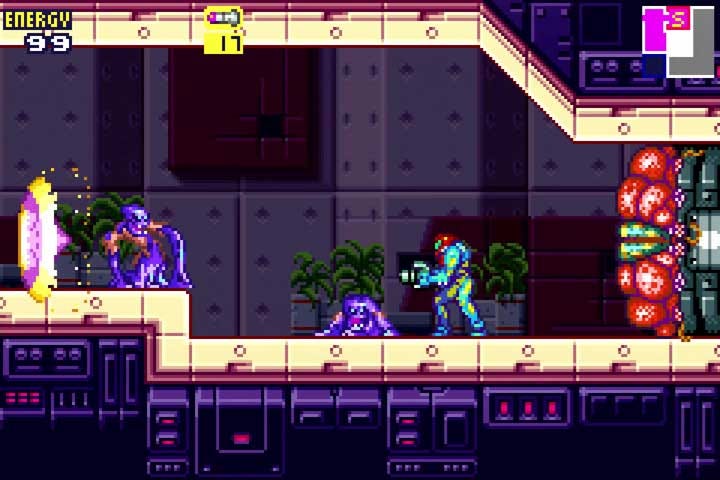
Metroid: Zero Mission for Game Boy Advance - Screenshots 
Metroid: Zero Mission (2004); improved visuals, and there’s a map this time!

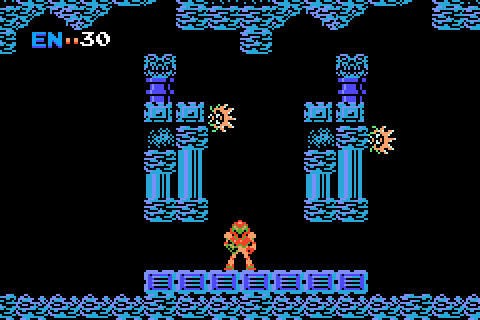
People generally consider Zero Mission to be the “definitive way to experience Metroid 1,” and while that is true, if you end up liking the series and want to see where it began, attempting to play Metroid 1 later on isn’t a bad idea. Metroid 1 has a lot of repeated textures in it’s environments, making it challenging to discern one room from the next, which could make backtracking a living nightmare (of course, the defining feature of Metroid games). You had to use an external map, or create your own as you go. It’s definitely not the ideal experience to have as a beginner, making it hard to recommend. I highly recommend Zero Mission over Metroid NES for newcomers to the series.

Nerdly Pleasures: Metroid Classic NES Series vs. Metroid in Metroid: Zero  Mission - Not the Same 
Metroid NES (1986); you can already see where the environment textures repeat with the ceiling, and without an internal map, you will be lost. That’s a promise.

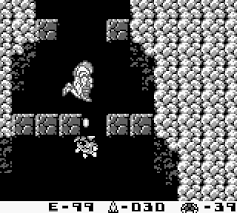
The stance on Metroid 2, on the other hand, is pretty solidly against the original version on Gameboy. Which, frankly, is fair; I don’t know many people who would want to play a Gameboy game in the modern era (other than, like, Pokemon). Take the un-intuitive map of Metroid 1 on NES, remove the color, and you get Metroid 2. Ideally, you should play Metroid: Samus Returns on the 3DS instead.

Super Adventures in Gaming: Metroid II: Return of Samus (GB) 
Metroid II: Return of Samus (1991); imagine this but weirdly green and on the dimmest, tiniest screen possible.

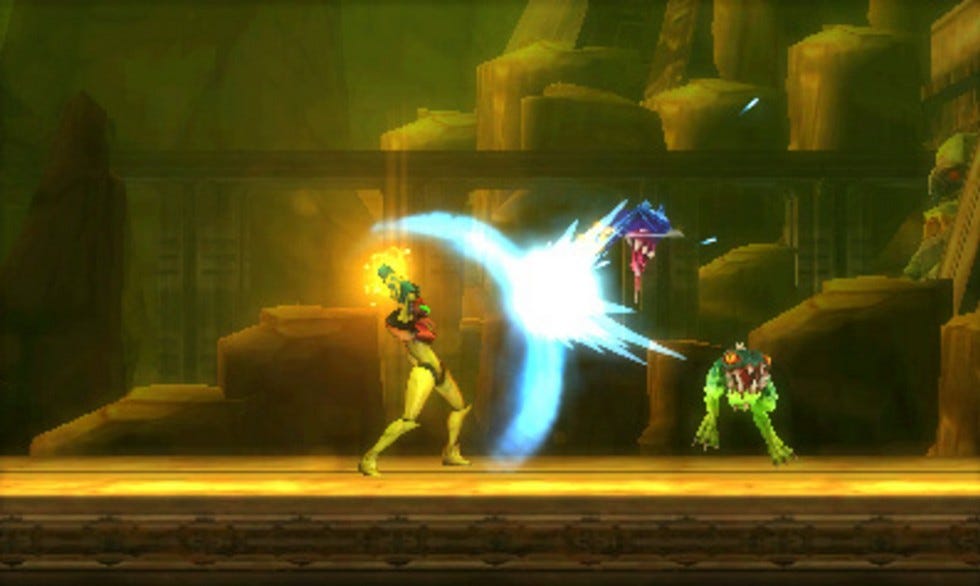
However, mildly controversial, but I don’t think you should play Samus Returns right after Zero Mission, because the controls might be off-putting specifically if you jump from Samus Returns into Super Metroid. Samus Returns is closer to Dread control-wise, so playing the most modern controls then the most classic controls might be a bit jarring. In that case, I would play Zero Mission then Super, and wait to play Samus Returns until you’re closer to playing Dread. Though, again, if you’re looking to play for the story, then playing Metroid 2 after 1 is ideal because 2’s story is immediately continued in 3.

Metroid: Samus Returns (3DS) Review – ZTGD 
Metroid: Samus Returns (2017); countering enemies is a key mechanic in this game and continues being relevant in Dread.

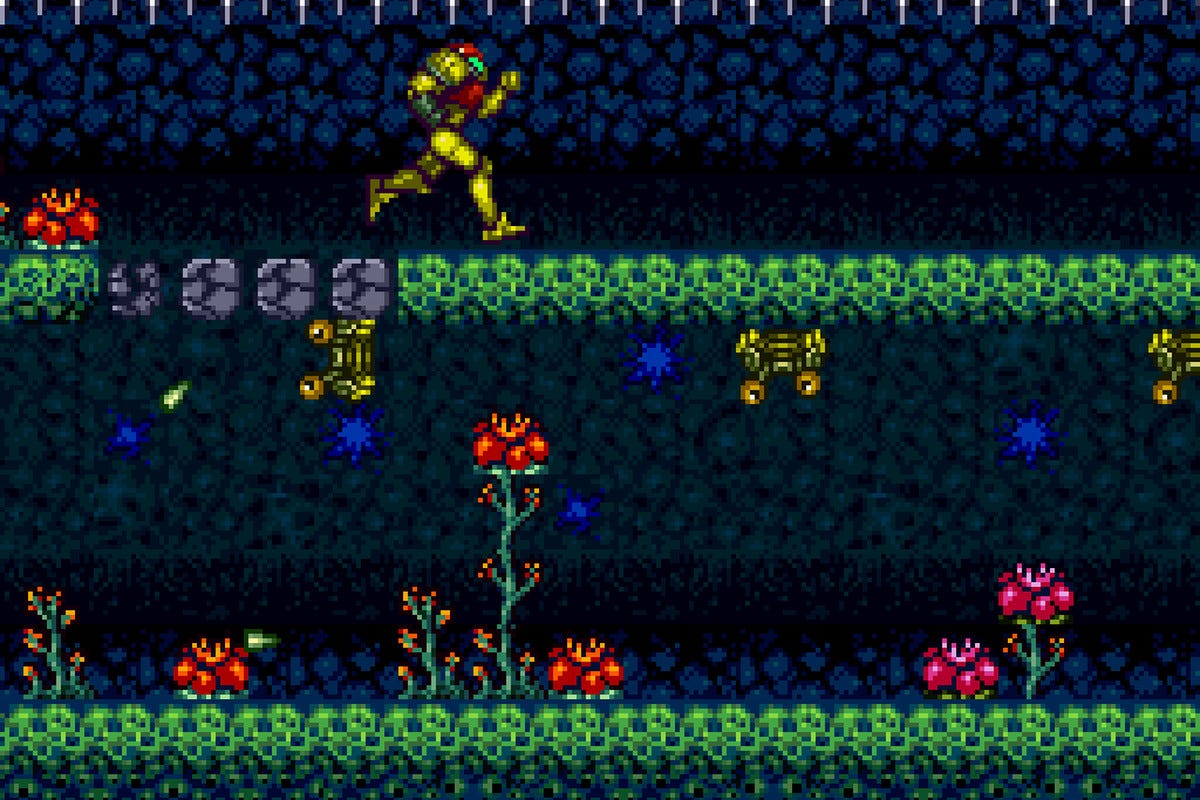
Metroid 3 is where the Metroid team kind of gave up on numbering the games, or at least colloquially. Yes, you see Metroid 3 in the title sequence, but no one really calls Super Metroid “Metroid 3.” It just is the 3rd Metroid. Super Metroid is a strange game because it’s beloved, but has never been remade, so your only option is to play the SNES version. Which can be a boon and a bane. Super Metroid, as beloved as it is, has really shitty physics and can be annoying to deal with. I don’t think it ruins the experience too much, as Super Metroid was the first pre-Wii generation game I’ve ever beaten (and that’s saying something as someone who’s kinda ass at gaming). So, while Samus is incredibly floaty and unpredictable at times in Super Metroid, it’s still a phenomenal game that deserves the “classic game” status.

Game Informer Ranks Super Metroid As Still The #1 Metroid Game - Omega  Metroid 
Super Metroid (1994); improved graphics from NES/GB era, but janky controls and floaty physics make for an Interesting experience in the modern era.

Metroid 4, otherwise known as Metroid Fusion, is the only other game pre-Dread without a remake. Again, pretty straightforward of an entry; you should definitely play this after Super as the story is picked up immediately from where Super left off. Fusion’s development history is fascinating to me because the team seemed like they wanted to do justice to the Metroid series after Super, but following up after a classic like Super is hard. I think that care shows in the gameplay of Fusion; even if people love to dog on it because it’s a little linear, it’s still a phenomenal game. And my personal favorite in the series.

Metroid Fusion GBA Review – Road To Metroid Dread, Ep. 04 - Pug Hoof Gaming 
Metroid Fusion (2002); I have nothing bad to say about Fusion, it is the perfect game.

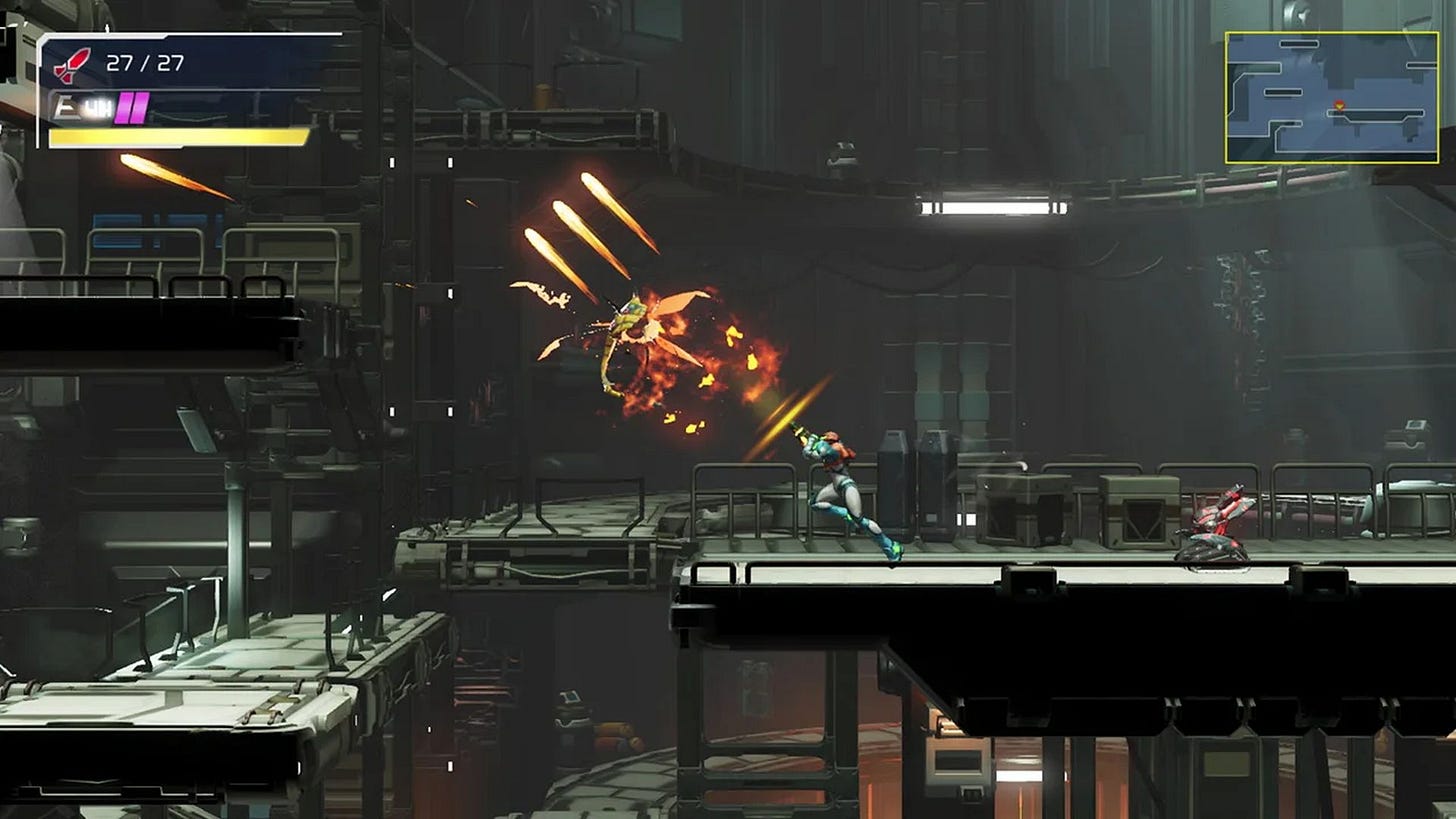
Finally, there’s Metroid 5, or Metroid Dread. The game that was originally going to release on DS before getting canned and repurposed into the Switch game we all know and love. I do think Metroid Dread is one of the better Metroid games, and this isn’t a recency bias thing. It just is that good. I mean, they finally got the movement figured out, and it excels in this game. If you’ve played Samus Returns, Dread will feel incredibly similar as it was made by the same team, so the counters and teleportation stations and level design and movement are all pretty similar in Dread, if not refined with the Switch’s capacity for larger games.

Metroid Dread Gameplay Footage Showcases New Abilities, E.M.M.I. and Much  More 
Metroid Dread (2021); we’re in HD now!! Look at how pretty it is!!

Dread is a really easy game to recommend for newcomers because it has the most modern controls out of all of them, and is the most accessible out of the bunch, but I still think it’s more fun to see that progress first hand, rather than play the best from the get-go and have to struggle through the rest.

3D Metroids - Prime Series

Chronologically, the Prime series is placed between Metroid 1 and Metroid 2 for reasons that become very obvious the minute you play Metroid 2. Though, I don’t know many people who would seek out playing Prime in between 1 & 2, simply because the Prime games are so vastly different than 2D Metroid.

While structurally the Prime games are also Metroidvanias, there’s a lot less of a learning curve involved than 2D Metroid. Given it’s 3D nature, maps are wider, which gives lots of room for exploration and story development compared to previous entries, but the most you’ll be doing in a Prime game is jumping from one platform to the next. There’s no shinesparking, which has it’s pros and cons.

Prime is probably another easy way to get into Metroid, but should be noted that it’s a spin-off. None of the other games play like Prime. So, if you’re used to 3D environments, open-world exploration, and first-person controls, it’s not too different from other games in that genre.

There is a correct order to play the games since they’re more notably numbered, but I have a feeling Prime 4 is going to push things into a less structured order. The Prime Trilogy should be played in order, then probably Prime 4 after. Note that as of this post, I haven’t started Prime 4, so I don’t know what direction it takes the series.

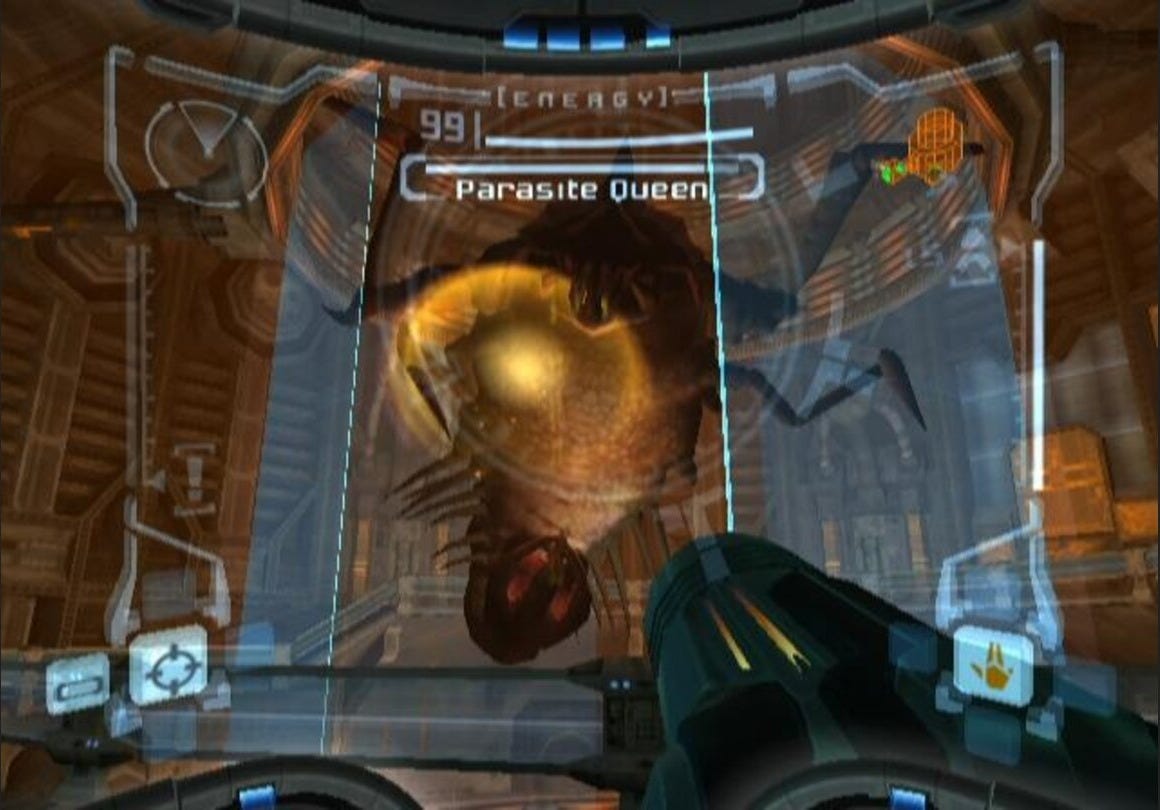
Starting with Prime 1, you’re given a lot of options and control styles. It really depends on which control style you prefer, as there isn’t one style that’s better than the rest. You could pick up the Prime 1 Remake on Switch, and be given the option between all three play styles at once, or pick up the version that you think will be best tailored to your preferences.

Metroid Prime GameCube 
Metroid Prime (2002); this boss (the tutorial boss) had me stuck in the GameCube version for years. In Prime Remastered, I beat the boss like it was nothing.

As it stands, I think I recommend picking up the Prime Trilogy on Wii over the Prime 1 Remake, especially if you plan on playing all of the Prime games. There will be less confusion on control schemes between entries since the controls stay the same all the way through Prime 3. The Prime Trilogy versions of Prime 1 and 2 let you choose between GameCube controls, where you have to stand in one place to aim, or Wii controls, where you move with the Nunchuk and aim with the Wii-mote.

Buy Metroid Prime 2: Echoes for GAMECUBE | retroplace 
Metroid Prime 2: Echoes (2004); what if we took the multiple beams from Prime 1 and limited the ammo in them? Surely this will go over well.

However, because Prime 3 is solely a Wii game and controls with Wii-mote and Nunchuk, I highly recommend playing Prime 1 & 2 with those controls as well. Makes the opening of Prime 3 a little less jarring.

was anyone else hoping a segment where you actually flew/dogfought with the  ship after having all this interactable stuff in the cockpit? i've always  wanted a ship-flying segment in a metroid game. 
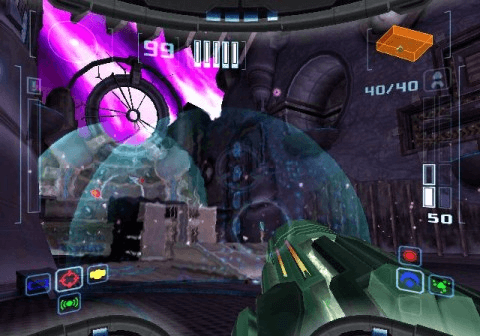
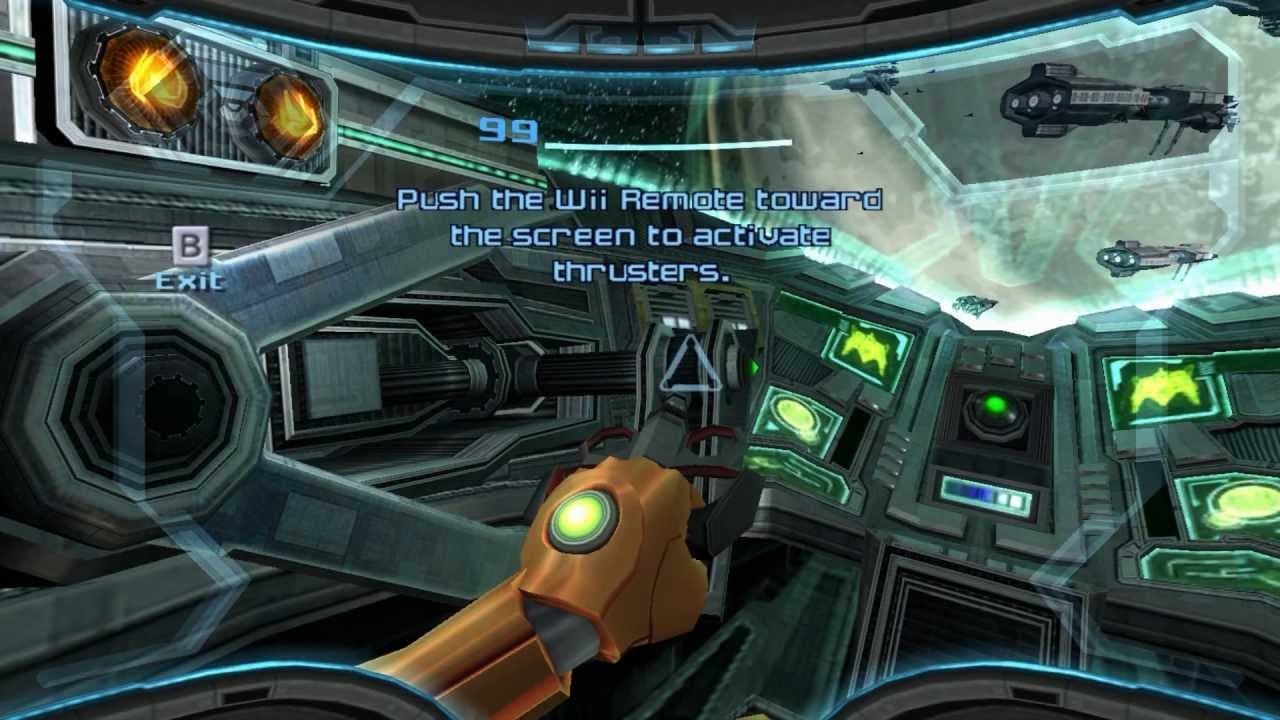
Metroid Prime 3: Corruption (2007); getting to move Samus’ arm with the Wii-mote was still jarring to me, despite playing Prime 2 on Wii

If Prime 2 & 3 ever make it to Switch, then I would recommend playing that version. That way, you get dual analog controls, which I think are the most intuitive. Either way, if you end up liking Prime and you want to give the GameCube controls a chance, I would recommend giving them a shot at some point simply to see Prime’s history.

Then, y’know. There’s Prime 4 after that. It just released. I don’t have much to say about it other than you should probably play it after Prime 3.

There’s also Metroid Prime Hunters for the DS, which is kind of a spin-off of a spin-off. It’s technically canon because it Sylux is in it and is a reoccurring character in the series, but it’s not fully necessary to play. Chronologically, it sits between Prime 1 and Prime 2, but because it’s a spin-off, you don’t have to play it in that order. You could pick it up whenever and still get the gist of the story. And, since it’s on DS, it’s controls are a little strange, but I personally don’t think it’s as bad as the GameCube controls. If you play Prime Hunters on a XL console (or emulate), you won’t really have a problem.

The Forgotten, the Maligned: Metroid Prime Hunters – Source Gaming 
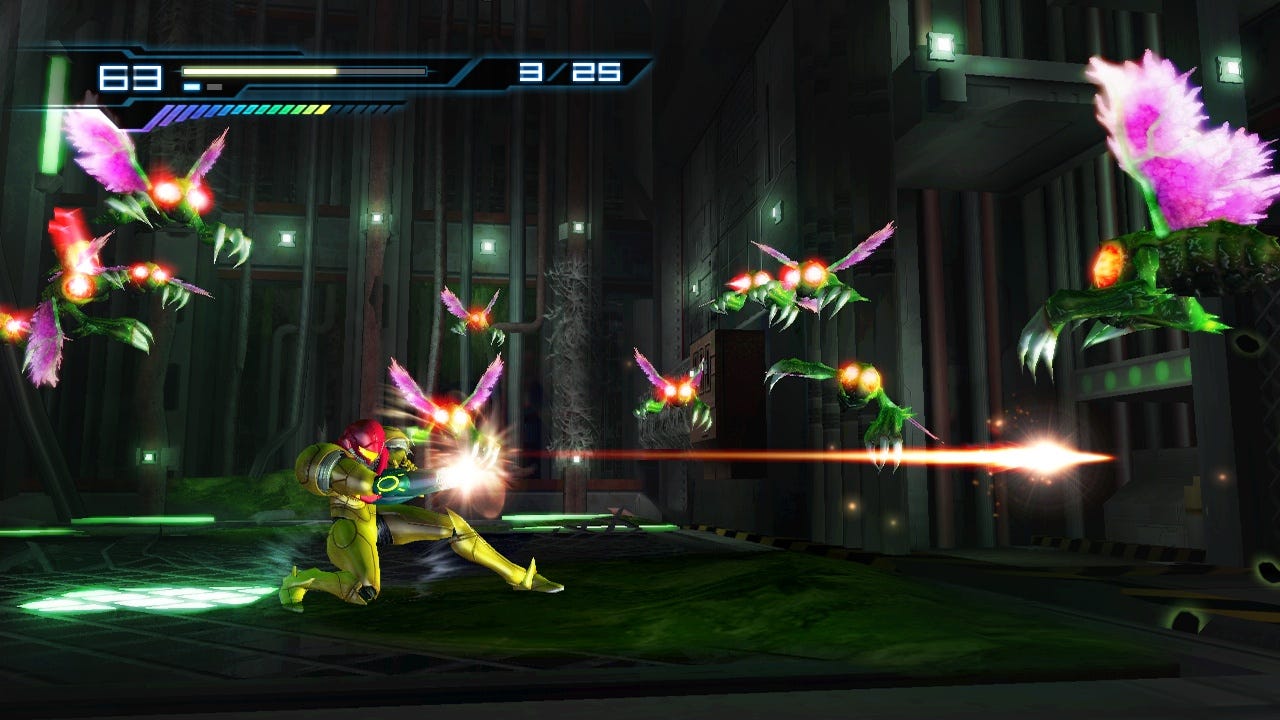
Metroid Prime: Hunters (2006); another Metroid 2 situation where the graphics and screen size make this game challenging by itself.

The Others - Games to Avoid

Of course, with a game series as old as Metroid, you’re gonna have your misses. These are games that technically fit in the timeline, but like…no one really likes them enough to acknowledge their existence. They sure are games, essentially.

These games include Metroid Other M on the Wii and Federation Force on 3DS.

Other M is a strange game. It’s technically set between Super and Fusion, and it makes sure you know it. It has probably the worst story out of all of the Metroid games, truly uninspired slop frankly. But, control-wise, it’s not too bad. Strange, but not bad. I think if you end up loving the Metroid series, you might want to check out Other M just because it’s a funny mark on Metroid’s history. Otherwise, you could fully skip it.

Metroid: Other M Review – Wizard Dojo 
Metroid: Other M (2010); look, it doesn’t look that bad and it doesn’t play that bad, but it is such a funny experience compared to the rest of the series.

Then there’s Federation Force, which if I’m honest, I’m still not sure what it’s supposed to be. It’s like a co-op Prime Hunters if Prime Hunters was bad. Hell, Prime Hunters has a co-op, so just play Prime Hunters. I don’t know why you would want to play Federation Force unless you’ve already played all of the other Metroids and want to be able to say you’ve play every Metroid game. Even then, I don’t think it’s worth it.

Metroid Prime: Federation Force | Nintendo | GameStop 
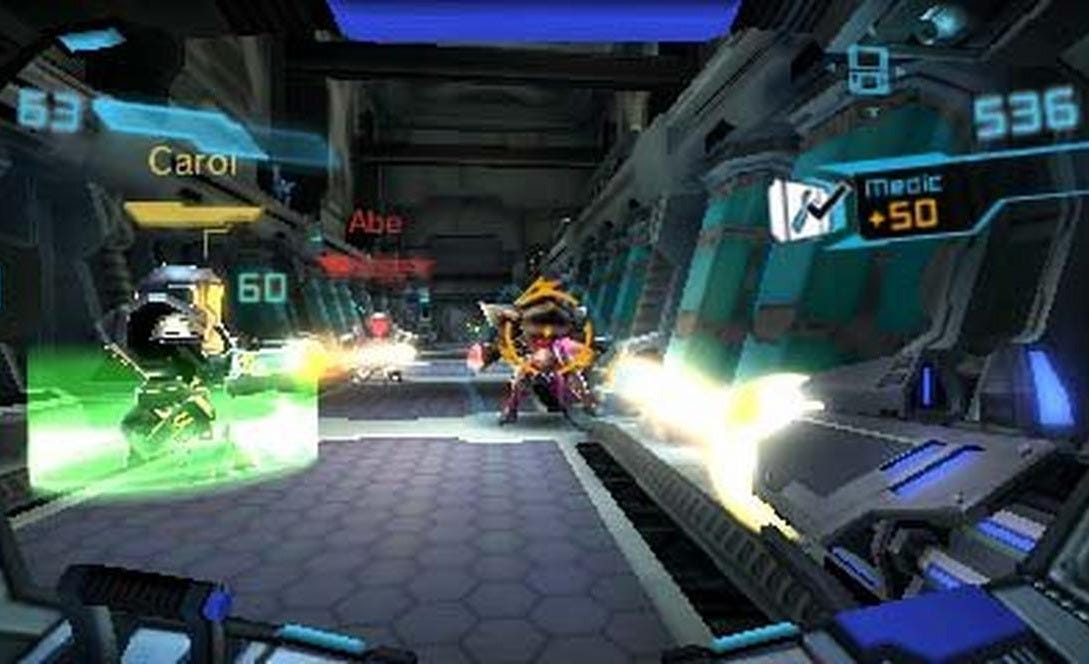
Metroid: Federation Force (2016); no amount of gameplay or reviews of this game can accurately describe what kind of game this is supposed to be to me.

Finally, there’s also Metroid Prime Pinball, which is…y’know…pinball. I don’t know why it’s technically a Prime game; I think it’s because it would be easier to market considering at that point, the only Metroid games that were releasing were Prime games, and before that was Zero Mission in 2004. It’s a pretty solid pinball game—I actually think it’s better than the Pokemon Pinball games—but it’s pinball. Nothing really out of the ordinary.

Metroid Prime Pinball - Wikipedia 
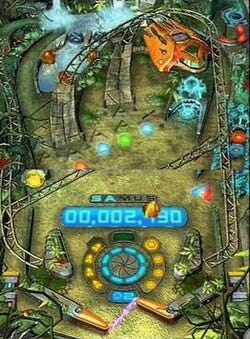
Metroid Prime Pinball (2005); love that it uses the dual screens of the DS like this, but like it’s pinball. It really is just pinball.

Ultimately, Metroid is a fascinating series. It’s been around since the 1980s like a lot of the classic, long-withstanding game series created by Nintendo, and yet it always feels like it’s been held at a distance. Not fully supported, but not let go of quite yet. It’s lauded quite heavily with Super Metroid, has high praise and heavy support in new releases, yet has the cult following of a niche series. It’s strange, but it’s one of my favorite game series of all times, so if I can convince anyone to get into Metroid, I will find a way.


And that’s about it! I should have an extensive review of Prime 3 coming up relatively soon-ish, so I wanted to get a little series wrap-up post out there ahead of time so more people are aware of what Metroid entails.

Are you a fan of the Metroid games? Which game is your favorite? Least favorite? Do you agree with my assessments of the games, or are you in an entirely different boat? Lemme know in the comments below!

Next week is already the end of February, so while I won’t have a main series post up next Wednesday, I will have my Monthly Backlog Stackin’ update post up on Saturday (2/28) at noon EST! I’ll talk in-depth about the books I’ve read and the games I’ve played over the month, so stay tuned for that!

And as always, see you next time!
February 8, 2026

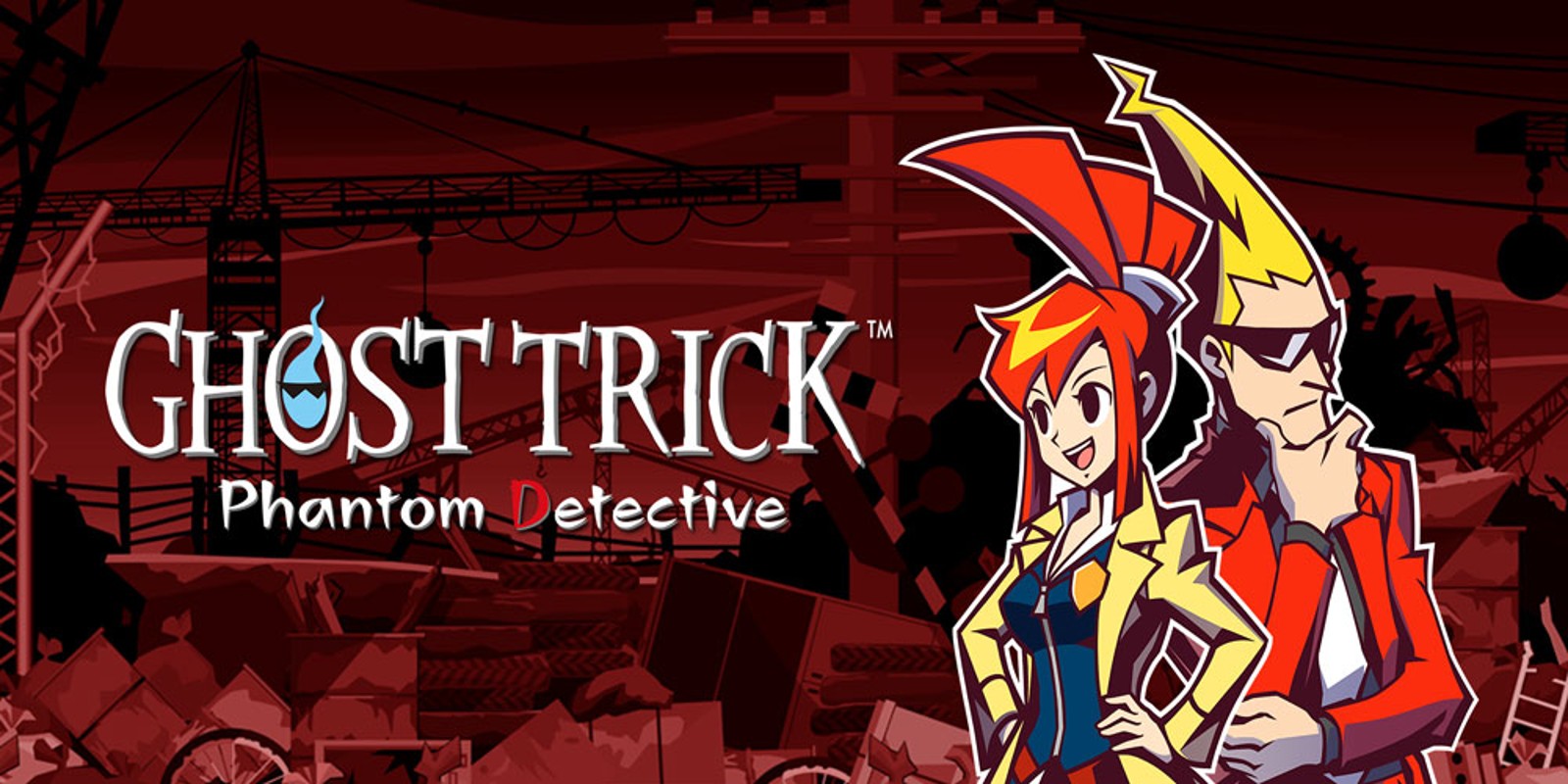
SFMR: Ghost Trick

 I mean, this was fully inevitable and only a matter of time for peak; you either GHOST or TRICK, quite straightforward.

Ghost Trick: Phantom Detective | Nintendo DS | Games | Nintendo UK

Ghost Trick, my beloved, I wish more people got to experience you.

This, of course, was an inevitable post for this mini-series. It frankly should’ve been the first post, but alas, one of the things that haunted me about it is that I had a really hard time remembering the plot of the game, now that it’s been five years since I first played it. Which, of course, is not ideal when you also want to review it.

So, over the last month, I’ve dedicated a good chunk of my time to replaying Ghost Trick. And let me tell you, it still holds up to this day.

Granted, I did not play the remake. I’m personally not fond of companies selling their retro games for full price (or near full price), so I’ve been waiting for it to go on sale for something more reasonable (and generally less than what the going price of the original is). I’ll be reviewing the original DS version in this post, for clarity’s sake.

Ghost Trick might just be the perfect game. Not only is it a simple concept to pick up, it’s one that’s so effortlessly charming in it’s presentation and storytelling. Now, of course, I refuse to spoil this game as it is truly something you should experience for yourself, but let me emphasize how beloved this game is.

It’s quite an easy game to pick up. You—or well, the main character—are dead. You’re granted powers in the afterlife to rewind time for fresh deaths that occur around you to figure out how that character died and perhaps even save them. You traverse across the map through inanimate objects that you possess, “tricking” them to activate and change the course of fate.

Despite this concept seeming easy to grasp, you are also working with a time limit. One that is mildly artificial, in that you have to solve the case of your death by the end of the night, and one that is much more realistic in the four minutes of time that you can rewind to save a life. I think this time limit is one of Ghost Trick’s best mechanics.

In this four-minute interval, you have to quickly assess the scene, see what causes the death of the character you’re saving, and maneuver around the scene to interact with the right objects at the right time. If you’re too early or too late, you miss your opportunity and fail the scenario. You genuinely are working with four minutes of gameplay here, watching as characters move into certain positions in the scenario. As they move, they may move an object that you need to be possessing so that you can continue the objective, or else you’re stuck on the other side of the map and will have to reset. And resetting can be miserable, especially if you’re working with the three-second countdown at the end of the scenario.

As far as I’m aware, there’s no true way to fail these four-minute sequences. You are always given the opportunity to start back at the beginning of the sequence, or if you made it far enough, to the moment where you changed a characters fate, even when you fail. Even if this sounds very lenient, I think that the puzzles are challenging enough that you might have to reset multiple times to properly understand the timing.

If you’re ever lost, or confused on how to progress in these sequences (and throughout the game), there are multiple optional dialogue sequences you can watch to better understand what works in the four-minute interval world and what doesn’t, what pieces move and function in what manner, and what sequence of events might need to occur in order for you to progress. You might examine an object and learn that it’s inaccessible because it’s tied to a mechanism you can’t directly interact with, or you might solve a puzzle but realize you need a ramp to hit a ball off of, and have to reset with that knowledge in mind.

A lot of the time, you’re reconfiguring the timing, practically speedrunning the level to make sure your possessing the right item at the right time and activating it at the right time in order to solve the puzzle. It’s very intuitive, and one of my favorite parts of the game.

Outside of actual gameplay, the characters and animations are the heart of this game. The motions are lively and expressive, which, if you’re an Ace Attorney fan, should look familiar as the game was created by the father of Ace Attorney, Shu Takumi. A downcast and dejected character will physically slump in their chair in a huff, or a very energetic character may dance across the scene in jovial pursuits. It makes the game feel alive, even when you—the player character—are dead.

A lot of these characters can be quite eccentric even despite discussing events that are quite intense or regretful, giving that familiar blend of whimsy and seriousness that Ace Attorney is well-known for. As you start unraveling the secrets of the night and the mystery behind your death, the story really starts ramping up and it’s like every little detail down to the Chicken Kitchen is involved in some capacity to not only your death, but the deaths that surround you. Everything, and I mean everything is perfectly tied up in the end in such a satisfying conclusion, you’ll wish it didn’t end so quickly.

I love Ghost Trick. I think it’s truly one of the best games of all time, and I’m sad that not a lot of people have heard of it or played it. If you’re an Ace Attorney fan, or an enthusiast of lost DS games that have a cult following, I highly recommend you check out Ghost Trick if you get the chance. 10/10 game, no notes.


And that’s about it! Have you played Ghost Trick? Have you played the DS version or the Switch version? What part of it do you enjoy the most? Lemme know in the comments below!

Going forward, this series of mini, spoiler-free reviews is no longer going to have an upload schedule, mostly because I can’t keep up with it. As much as I like being able to play or replay games to write about them for this series, there aren’t a lot of people who check this out, so I’m only gonna post when I have something I want to write about. That way, I can focus on my main posts. From here on out, if I do have a post to upload for this series, it’ll drop on a random Friday at like 5 PM EST or something.

No post next week! My next upload will be the first part of a three-part “How to Get Into [Blank]” series, and will be posted on 2/18. Starting with Metroid since I should have a review of Prime 3 coming out soonish afterward, for easy referencing.

As always, see you next time!


February 4, 2026

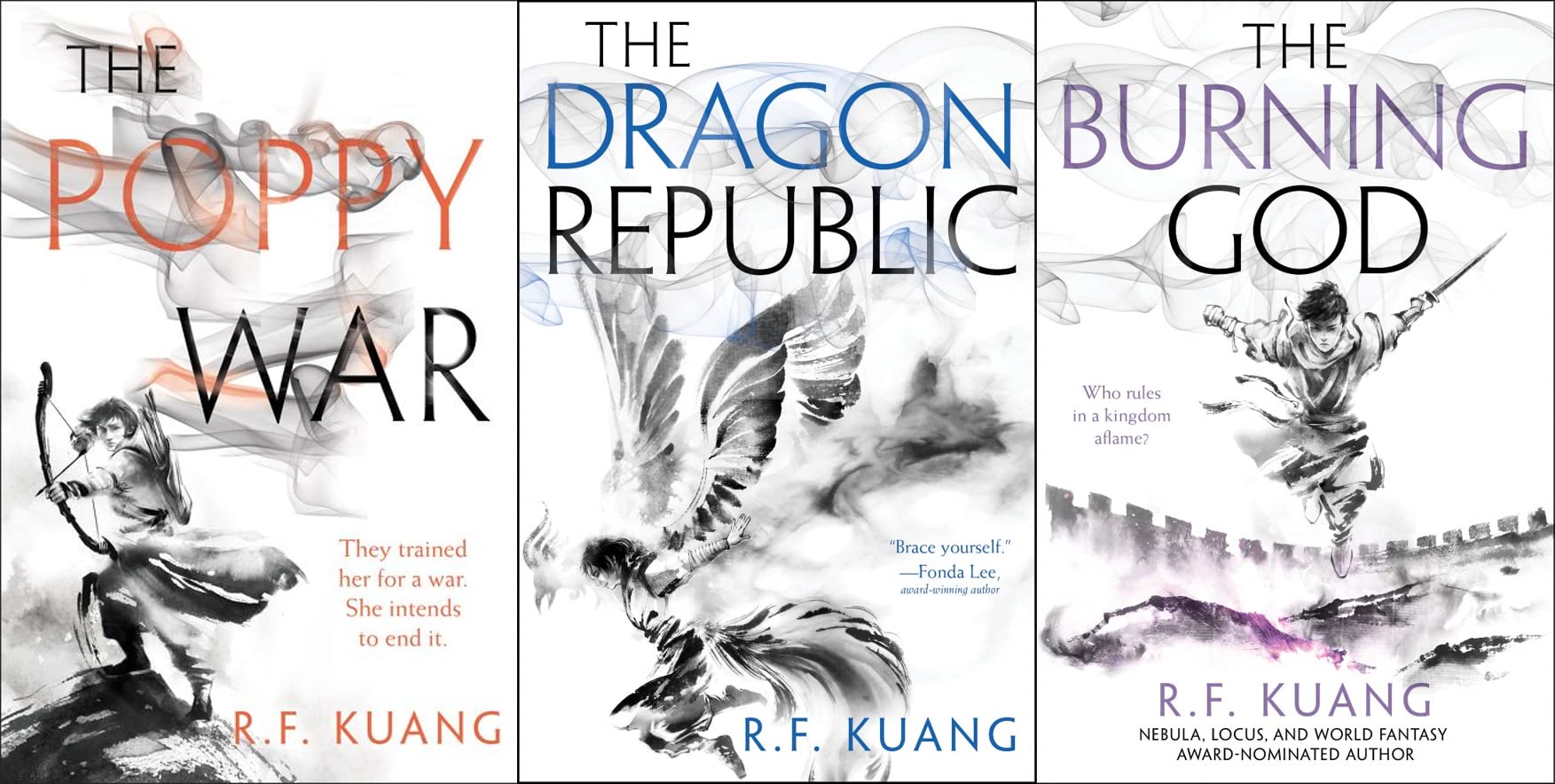
The Poppy War Trilogy: How Far We've Fallen

 I had so much hope for this series, man...what happened? 

The Poppy War Trilogy Set: R. F. Kuang: Amazon.com: Books


What Consoles Do I Collect For?

And other queries about my game collection and game collecting as a whole.    Ever since writing my “How Emulation Changed My Life” post, I’...