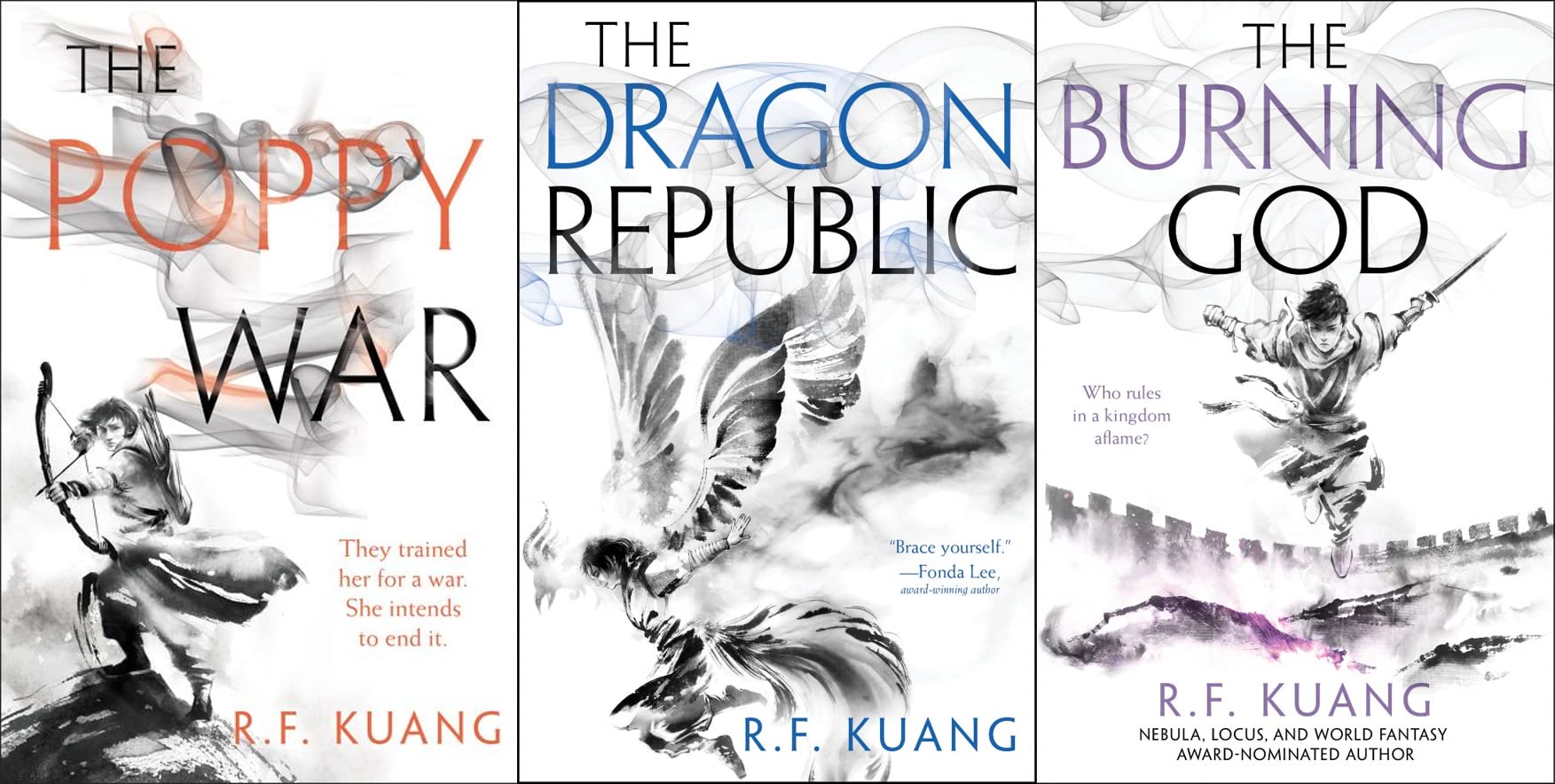
But, I have to ask: Why not? How could you get through all three books and not feel incredibly aggravated about the pacing of these books? How could you manage to suffer long-winded passages of unnecessary fluff and not hate the series by the end? How did you do it?
Because as it stands, I’m shocked I didn’t DNF the series during The Dragon Republic. And part of me wishes I did.
Let’s start with the basics here: this post will be quite spoilery, so if you haven’t read the Poppy War series by R.F. Kuang and you want to not be spoiled, I would skip out on this. Or, if you wanna know why it sucks majorly to know to avoid it, be my guest.
Also note, this is nothing against R.F. Kuang as an author. I do think R.F. Kuang is a talented writer, which is showcased throughout the series, it’s just that I have to assume there were some other forces preventing this series from reaching the peak I had hoped for after The Poppy War because of how poorly they were paced.
Let’s begin.
The Poppy War
Out of all of the books in the Poppy War series, The Poppy War (TPW) is objectively the best book, bar none. R.F. Kuang is phenomenal at writing awful protagonists who do unjustifiable actions, but because you (the reader) are constantly in their head, you sort of make slight justifications or understand why the actions were made while you read. Being able to write such morally gray characters is a talent, and R.F. Kuang does a fantastic job at this with Rin.
TPW starts with the character Rin, or Fang Runin, an orphaned child who lives in an impoverish town in Rooster Providence, Tikany. She’s studying all she can for the Keju test to get into the most pristine and elite military academy in all of Nikan.
She manages to pass the test, which is unheard of for a poor southern girl, so of course, Rin experiences a lot of classism once she arrives at Sinegard. The entirety of the first two acts of TPW are about Rin getting to Sinegard and then her time at Sinegard itself.
These sequences are very solid, building upon each other to led to the inevitable war at the end of the book. There really isn’t a moment in the beginning or middle parts of this book that feels unnecessary or unimportant. You really get to understand how Rin interacts with her peers; how she’s a bit unstable when it comes to studying and being perceived as a diligent worker despite her upbringing; how she’s a generally antsy person who wants to see immediate results, regardless of how much Jiang insists that she needs to take shamanism slow; how she never really fits in, and is defiant of her superiors; and establishes her relationships with important character that continue thorughout the series, like Jiang, Kitay, Nezha, and Venka. I cannot stress this enough, The Poppy War does such a phenomenal job setting up the story, setting up the protagonist’s motivations, and introduces the main conflict that persists through the rest of the series.
Even as the war begins, and there’s a bit of a sudden shift in narrative to being primarily a war-driven story, it’s not hidden that that’s the end goal for this series. That another Poppy War is destined to happen because the Warlords cannot agree on anything and constantly have in-fighting. That Mugen is going to see that weakness and take advantage of it. Sure, it might be jarring at first, but it’s called the Poppy War series for a reason; it’s not like there isn’t going to be a war plot.
I think my only complaint with the first book is the stuff with Altan and the Cike. Altan is introduced as this godly character that cannot be harmed, and Rin immediately resonates with him. Eventually, it becomes known that Altan is not only the “only survivor of Speer” but also a Shaman, and can also call upon the Phoenix goddess like Rin. However, his leadership of the Cike feels kinda thrown in last minute. Like, yes Altan is a few years older than Rin, so when he graduates, he immediately joins the Cike and is apart of them for a few years before Rin’s ever involved, but just because he’s strong doesn’t mean he’s the best option to be the general. He really isn’t more than a kid leading a group of estranged yet godly humans; why would he know how to do that after only being apart of the Cike for a few years?
The whole purpose of the Cike is to be an assassin organization of shamans for the Empress, and yet that plotline just kind of…ends? Like, the Night Castle is completely forgotten by the end of the book, they mostly just become the 13th Division in the Imperial Army and aren’t even doing a lot of spy work, and the Empress just ends up killing Commander Tyr—the first commander of the Cike known to the reader—just…because? Because the author needed Altan to be the commander, but didn’t know how to make him one without killing the previous commander? It just seems unnecessary, and frankly, sets the Cike up for failure in the upcoming books.
I feel like a lot of the problems of this book, and subsequent books, can be tied to the Cike floundering after Tyr’s death and Altan’s poor job of commanding the Cike. Rin sees Altan as this godly, untouchable person, but in reality, he didn’t know what direction to take the Cike, and that stress ended up killing him.
TPW is so close to being a perfect book, like everything else about the book is so enticing and exciting to read, but it’s ending is so incredibly jarring that I can’t rate it higher than an 8/10. And, unfortunately for The Poppy War fans, these ratings only get worse.
The Dragon Republic
Starting The Dragon Republic (TDR), there’s a lot of hope and almost absolutely no chance for it to flop. After TPW, there were so many places for TDR to go, so many opportunities for the future of this world and its characters, there was absolutely no shot that TDR could be bad.
But, then, you read TDR. And quickly realize, oh shit, this is a god-awful book. At the same time, you don’t want to admit that TDR is bad quite yet, because you still remember all of the highs of TPW and haven’t been burned (literally) by The Burning God.
The Dragon Republic is the most second-book-in-a-series book I have ever read. Truly, you could skip TDR, move on to The Burning God, and not miss much. That’s actually probably the best way to read this series: don’t bother with The Dragon Republic.
There is so little good in TDR, it’s truly impressive. It’s boring as hell. Nothing happens for 500 pages. Rin is zonked out of her mind for the majority of it, and it shows! It picks up right where TPW ends, which is promising, but then you sit and read Rin be an awful leader of the Cike, a role she didn’t deserve and said multiple times she shouldn’t be, for the entire first half of the book. She’s guilt-driven and angry, constantly smoking to forget the fact that she set fire to an entire country and it didn’t end the war, and horrifically fumbling the leadership position Altan forced her into.
All the while, Rin joins the Republic for their rebellion because, apparently, Su Daji is evil or something, and the Cike go with her because she’s their leader. So, now they’re not the 13th Division or the Empress’ assassin organization, just because Rin says so. Thus, promptly, the Cike cease to exist, more or less, like you don’t see them again until the very end where the author kills them off to save Rin, and you snap your fingers with a lightbulb over your head like, “ohhh, right, I forgot about the Cike.” They serve barely any purpose to the narrative at this point, they don’t drive Rin to become a better person, and are really only there to be Rin’s puppets, to be disposed of when their purpose is served. Which, I guess is good character development for Rin some regard, but also what was the point of the Cike at all?
I found that the only interesting thing about this entire 600-page book is the shamanism and the Pantheon of Gods, which upsets me because it’s barely a plot point in this book. Without the Cike, Rin’s the only one that can call the gods in the entire book, and sure there’s a moment there where Rin starts believing Nezha might also have a god, but it’s only a topic of suffering for Nezha. So they just don’t talk about it. And frankly, anything interesting about Nezha’s abilities don’t come up in this book at all! It’s not until The Burning God where that plot point is put to use, so I ask you: what was the point of this book?
There’s a section in the middle of the book where Rin runs into the Hinterlanders—or rather, the Ketreyids—after getting blocked from the Patheon by Daji, learns what the Trifecta did to Ketreyids, and gets anchored to Kitay. This is literally the only interesting thing that happens in this book up until it’s conclusion.
Throughout the book, there’s some war stuff going on, but it’s so boring, I simply cannot summarize it. Like, the Dragon Republic moves up the river incrementally for like 300 pages, then realizes it’s winter now so they can’t continue advancing and return home. Great. What a waste of 300 pages. And frankly, a lot of it is waiting for the Hesperians to join the fight, so it’s like a one-sided rebellion for 600 pages with Daji just kinda taunting the Republic the entire time. And when the Hesperians do show up, progress against Daji just isn’t made. So like, again, I have to ask: what is the point of this book?
Rin ends up being betrayed by Nezha, and captured. She escapes the Hesperians hold, but through very frantic measures where Kitay helps her escape by smashing her hand to slip it out of the manacles right before the Hesperians show up. And I’ll admit it: this ending was quite good. It almost made me rethink how I felt about the entire book up until that point, but again, the pacing just wasn’t there.
Truly, this book was a slog to get through, and because of that, I cannot in good conscience rate this higher than a 4/10. If you survived reading this miserable flop of a book, godspeed soldier. I’m so sorry for your loss.
The Burning God
And then, you have The Burning God (TBG). The final book of the trilogy. There were such high stakes for TBG to be good that it almost made it hard for me to want to read it. Like, I left The Dragon Republic almost feeling hopeful, and yet, there’s something quite sinister about the pacing of TDR that did not give me hope for TBG. I could’ve left the series there. Give it a mid rating. Leave it at that. But, I had to see it through.
TBG starts off alright, I will give it that. There are a lot more interesting scenes going on in this book compared to TDR, but the problem is that the conflict is exactly the same. Three books in and Rin still is struggling with authority, desperately wanting to control her own legion in the military but not being trusted with it because she’s “too young” and “inexperienced.” This was the same conflict in TDR, written in the exact same way with no evolution on Rin’s part at all. She starts trying to vie for the attention of the male leaders of the military she’s a part of, getting attached to a guy who seems to have his shit together—Yang Souji this time, instead of Nezha—and right when she starts to understand her feelings for this guy, he completely betrays her and stabs her in the back (or, not literally this time, instead sells her off to the Republic). Like?? Do we need another failed romance plotline? Three for three, and at this point, Rin should start questioning if she’s even attracted to men to begin with.
And that’s the other thing! All she ever does is compete for the attention of men! Rin spends too much of her time talking to guys, about guys, her entire f!cking personality is about trying to become a good enough soldier for the male leaders in her life that don’t see her as anything more than a token to exchange in battle, and the only women she ever confides in are people she doesn’t trust! She doesn’t trust Venka with her concerns, so much so that it leads her to start actively thinking Venka is a spy (and ends in her dismay), and outwardly hates Su Daji…because she’s a war criminal? Guess what, Rin! You are too!
God, Rin’s internalized misogyny just gets so obvious and so vile in this book, I literally couldn’t take Rin seriously in half of her monologues to herself. And it sucks that it never gets resolved.
One thing that kept me going through TBG was the shamanism sections and the parts about the Trifecta. God, I wish R.F. Kuang spent more time talking about the shamanism in the book because, to me, that’s what kept the series interesting. That’s what made it unique compared to all of the other war-driven fantasy series out there. And yet, there were so many pointless sequences of fighting. I think the shamanism plotlines ends up saving TBG for me in the end. Midway through, I was fully ready to rate this a 4/10 and go on with my day. But, there was just enough set-up for the Trifecta and shamanism being important to the plotline that I had to see it through.
Rin being forced to follow the Trifecta, learning about what they did to her home country of Speer, and all of the heinous acts they committed during the Second Poppy War, was probably the best choice for the progression of this book. Hell, even killing the Trifecta off in the middle end was a perfect conclusion to their plotline, where Rin can acknowledge all of the good they’ve done to help her succeed and yet hate them simultaneously for all of the torment they brought to Nikan. The Trifecta, specifically Su Daji, did what they did because there was no other option, and there’s a moment in there where Rin realizes that she is in the same position that they were all those years ago, and chooses to end the reign of torment by killing herself, instead of letting her legacy live on and haunt the country. This was fantastic to read, truly phenomenal.
A lot of the stuff regarding the shamans, how Rin helps tutor others to become shamans and learns how far she’s come from being that surly teenager in Jiang’s garden, is fantastic, and yet, R.F. Kuang just kills them off like the original Cike. I get why she did it, I get that all shamans either die or live long enough to get imprisoned in the Chuluu Korihk, but come on. To kill off every single shaman almost feels like the author didn’t know what to do with them. And I wish, I wish to god at this point, that shamanism was the focal point of this novel series. If that was the main plotline through it all, that shamans either die or get imprisoned in the Chuluu Korihk, that everything that they do is on a time limit, then this ending would’ve felt deserved. But because so much time is spent discussing the war, fighting in the war, traveling to the next spot of the war, speculating what the Republic is going to do in the war, the shamanism not only feels bogged down, but a last minute addition to the story.
TBG had so much going for it, and fumbled almost every single plotline. At some point, it felt like the thread between all of the plot points were being held together by duct tape, like the Southern Rebellion to the Trifecta stuff to the end with Nezha, Kitay, and Rin barely had a common thread other than being in the same book. There’s a point where Rin compares her, Nezha, and Kitay to the Trifecta, and it’s like?? Kitay is wooden block of a human who isn’t actually a shaman, or did you forget that? Like, holy shit. I had to skim to get to the end because there would be like 20 pages of good writing, mixed in with like 75-100 pages of boring writing. Miserable book to read.
All in all, the trifecta stuff really saved this book from falling lower than a 5/10 for me, so I’m giving it a solid 6/10. I would only recommend this book to people who’ve made it through The Dragon Republic, and no one else.
Overall Thoughts
The Poppy War series really disappointed me. I can see why it’s a beloved series, why some people might even rate it highly, because it does have a lot going on! But it has just as much boring and unnecessary writing in it that you have to trudge through to get to the good stuff, and man! I don’t want to read a book like that! I want to read a book in it’s entirety and not feel like I have to skim in order to get it over with!
I’m so torn on the series because the highs are so high, but the lows are devastatingly low. I know for a fact I won’t ever read this book series again, but I can’t bring myself to get rid of it either. It’s definitely one of those book series that will sit on my shelf until the end of time, where I will constantly pull it out to complain about it and nothing else.
Of course, this is just my opinion. Maybe if you read it, you might end up liking a lot of the stuff that I found incredibly unnecessary. It might even be your book series of all time. It just isn’t mine.
And that’s it! This is probably quite the controversial opinion, but I think it needs to be said. The Poppy War trilogy truly was the object of my attention throughout 2025, and if I don’t say something, then that was roughly 1,600 pages of reading and multiple months wasted, and I can’t have that.
I think my favorite part about my experience reading The Poppy War trilogy is the fact that in the time it took me to read all three books, I managed to finish the Red Rising Trilogy in the meantime. Like, removing the fact that I waited a few months to pick up TDR and TBG, it took me 8 months to read The Poppy War trilogy, and only 2 months to read the first three books of the Red Rising series. If that doesn’t tell you how rough it was to read The Poppy War trilogy, then I don’t know what does.
Lemme know you’re thoughts on the matter, what you liked about The Poppy War series, what you disliked, and what you’ve been too afraid to admit about it. This is a safe space for discussion, and I’d love to understand what the other side thinks!
This Sunday, I have a Sunday Mini Stackin’ post going live about Ghost Trick, my beloved, so stay tuned for that! And again, in case you missed it, I’m shifting my upload schedule this month. This post and my Ghost Trick review are the outliers for this month, so once that review goes live, my weekly upload schedule is officially over! But, don’t fear, I’m not done with Substack yet; my next main post will go up on 2/18!!