

Something you should be aware of is that I’m an avid game collector. I collect games for almost every generation of game console, or at least for everything that is available to me. For the last five years, I’ve been in and out of game stores, garnering a collection that I can say I’m quite proud of. Every once in a while, I might purge the collection of games I can’t say I care for, but lately, figuring out emulation has opened a whole new world of demoing games before I buy them, thus perfecting my collection of games that are meaningful to me.
For this reason, I can safely ask: what the f!ck is wrong with the retro game market? (I’m gonna make it clear here, I’m referring specifically to the US region, not PAL or NTSC-J; I’m less familiar with those markets…though, if you have insight, leave a comment on this post!)
Retro game prices have been on the rise for quite some time now, give or take the last five years. Every generation has experienced a price hike. Usually, a generation of gaming will experience a price hike when a certain group of people reach an age in which they can be nostalgic for a game console they grew up with. Which, in retrospect, is all fine and dandy. But, for whatever reason, simultaneously, we are seeing a continued price hike in N64, GameCube, and Gameboy Advance games, while also seeing Wii and DS games hike up in price as well.
To put it into perspective, 3DS games are still priced around $40 consistently across the board. There hasn’t been enough time since the 3DS’ generation for 3DS games to drop in price. And yet, DS games are hitting an all-time peak. Why?
Side note: This is mainly an issue with Nintendo games specifically, as both PlayStation and Xbox haven’t really seen as much of a drastic price increase comparatively. There are, of course, outliers, but this post will be primarily talking about Nintendo games.
Generational Issues
Part of me questions if the reason why game prices are hiking in such strange manners is because of just how many games released during the late 90s to early 00s, and how that greatly affects that generation of gamers as they reach adulthood. If you know anything about Generation Z—people born between 1997-2012—you should know that this generation takes up a lot of cultural development time. Most of us have memories playing the Gameboy Color in dentist waiting rooms, checking out the GameCube at our friends house, and excitedly playing the Wii on Christmas morning, 2007 (because I know y’all didn’t get a Wii in it’s release year, be so for real). However, a lot of us also remember the Wii U’s catastrophic release, and played our first Pokemon games on our 3DS’ at the ripe age of 10-12 years old.
What’s fascinating to me as a Gen Z’er is just how much cultural advancement occurred when we were little, not mentally developed enough to properly process what was happening around us. I exist, at least, in a space where I can say I remember the roll-away CRT TVs in classrooms and those shitty old projectors with the clear pages, but can also say I grew up on social media like Twitter at its prime.
If you’re a cusper between Millenials and Gen Z, I don’t think this whiplash of culture is something you can properly say you’ve experienced, especially if you graduated high school during or prior to 2016.
In such a case, Gen Z is nostalgic for three to four generations of gaming at the least, and now that the majority of us are hitting adulthood, we can finally re-buy the games we played as children, however many generations of gaming that may be. Hypothetically, and I’m running fully on vibes here, we’re the second generation of gamers to exist in a world without ever knowing what life was like before video games. And as video games grow in popularity, especially over the pandemic, the urge to collect the games played as children grows as well.
The Internet Problem
Of course, the other issue regarding the price hiking of the retro game market is the popularity of gaming expressed through interested parties on the internet. In the modern era, we exist in a space where games can be played, reviewed, and attested to through YouTube, Twitch, and TikTok. People can see a game they may have never heard about, and through consistently watching content about that game, are recommended to play the game constantly. Thus, through the algorithm, games are shared at a much faster rate.
Now, this is more consistently true for modern games. I mean, how many of you bought Stardew Valley simply because you saw a YouTube video about it? Be honest…
Retro games are less commonly discussed on these platforms. Some popular YouTubers or Twitch streamers (cough, RTgame, Ludwig, Alpharad cough) might play an older game on stream, or talk about their favorite retro games, but for the most part, those collecting retro games and discussing them aren’t nearly as popular as those playing modern games.
While I do think that YouTube and Twitch (and reluctantly TikTok) are garnering an interest in gaming, there’s not enough hard evidence that this is the reason for the price hiking in the retro game market.
Scalpers, Scalpers Everywhere
The other issue is, of course, scalpers. Scalpers are essentially people that will buy a multitude of a particular item, and attempt to resell that item at a much higher price than it’s actual selling price online. And for the retro game market, a market where everything is limited stock and the demand is high, scalpers thrive.
Anywhere you look for retro games, you will see scalpers overpricing things to grandiose (and frankly, gross) degrees, making the market artificially rise. They buy up a bunch of copies, sell them for upwards of double or triple the current going price on the market, thus inflating the market, making other sellers up charge, and the rest is history.
Take Fire Emblem: Path of Radiance for example: this game is notoriously expensive in the game collecting scene. Currently, a Complete-In-Box (CIB) copy could run you $206 US dollars. Which, considering it’s god awful history on the market, isn’t half bad. However, if you went to eBay or some online retro game selling website (I’m not gonna name any names, but you can fill in the blank here), the price would be jacked up to upwards of $280-$350, or in the worse case scenario, $400. A game that’s worth less than $200. How does that make sense.
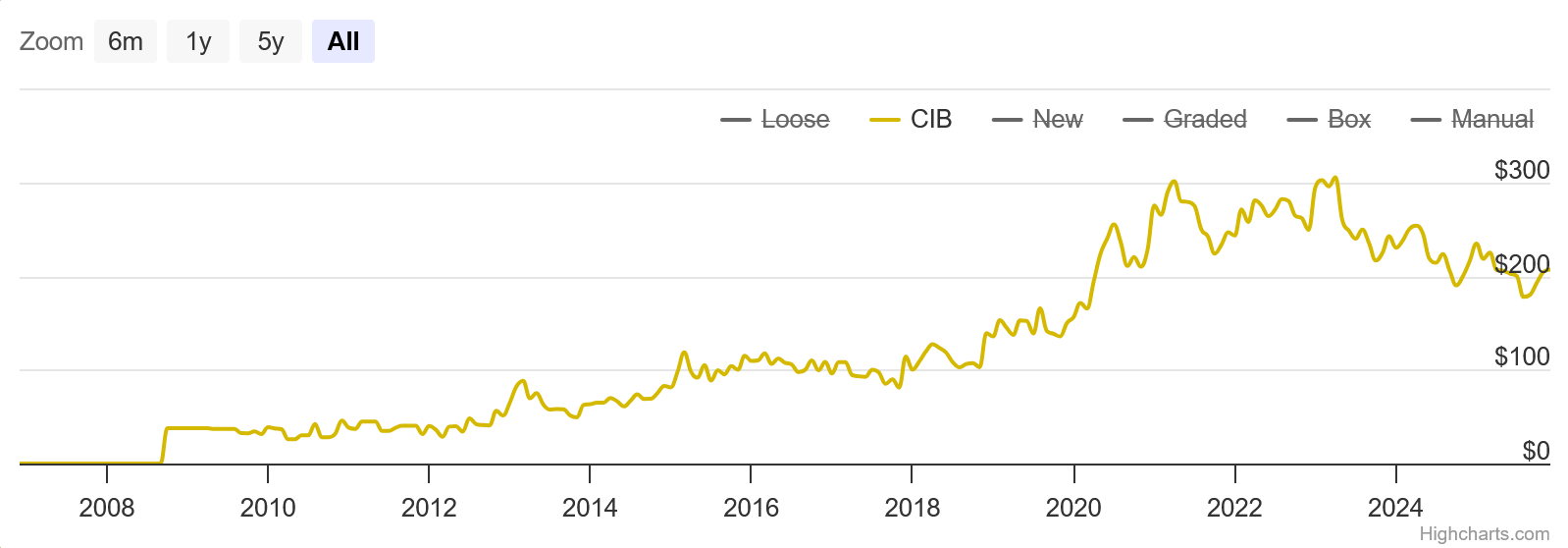
See, the problem here lies in reputability. Many people know Path of Radiance is hard to come by, so if they see it for a price that they deem is cheap enough, they’ll buy it, possibly without knowing that they’ve been scammed.
The unfortunate thing here is that there isn’t much else we can do about scalpers. The only thing you, individually, can do is not buy from a scalper, no matter how desperate you are. Be patient, wait for the right time, the right seller, the right price, and you’ll find yourself a deal in no time. And obviously, bite the neck off of the snake in the process. (Now that I’m thinking about it, I don’t know if that’s a saying…oh well, it is now.)
The Obvious Other Issue: Nintendo… *waggles finger*
I think, ultimately, one of the major issues as to why these retro games are hiking in price is simply because Nintendo doesn’t make their older games very accessible. Some games, sure, are available on Nintendo Switch Online (NSO). However, NSO costs a yearly price some people can’t afford, and more specifically, the games from the generations I’m talking about (N64, GameCube, Gameboy Advance) are locked behind an even pricier yearly payment, and even moreso, GameCube games are locked behind a $450 paywall of a Switch 2 along with the $50 price tag of the NSO Expansion Pack. Respectfully, most normal people don’t have that kind of money to spend to play a 20-30 year old game.
And, with the Wii U and 3DS eShops fully gone now for quite some time, there are less means to legitimately play these retro games that people love, as those eShops had long and large catalogs of retro games (and downloadable software no longer available, which is another topic for a different day) that are just…gone. Completely vanished from the air, as if it was never there to begin with.
This leads to people either purchasing Nintendo games through legitimate means via a game store or flea market, or succumbing to emulation, which is much more convenient and costs nothing.
With less legitimate means to buy games, especially those in Nintendo’s 7th generation of games, more people are flooding to eBay in swarms to find those nostalgic games that they can no longer play, thus inflating the market exponentially.
How Do We Fix It?
Ultimately, all of these reasons coincide with one another to create the current retro game market issue. Which is, essentially, retro games being way too expensive for what they’re worth, and continuing to spike in drastic ways.
Of course, there’s no actual means of deciphering what’s going on with the market without proper research over years of studying, and that’s not what this Substack is about. I’m mostly speculating here with years of experience under my belt, and a lot of questions on my mind, hoping to bring to light an issue I’ve been experiencing first-hand for the last five years. And maybe, just maybe, you’ve been seeing those prices yourself and wondering what’s up with them.
The good thing is that these prices have been going down recently. A lot of games that hit a spike in 2020-2023 are finally, finally going back down to a regular (or, well, more regular) price for the game, and I’m at least thankful for it, however long it takes to drop.
While there may be no means to make the prices drop, hopefully, as time goes on, less people buy overtly priced games, making the sellers with egregious pricing have to drop their prices to actually make a sale. Patience, unfortunately, is the only answer here. At least, that I can think of.
The Japanese Retro Game Market
Actually, I’m lying. There’s another answer to the high prices, and that is to look to the Japanese retro game market (I know, I know, I said that I didn’t know as much about it, but that is still true, I don’t know as much about it as the US region of games).
This, of course, isn’t something everyone can do. International shipping is no joke (especially these days…), and often, people don’t live in areas where Japanese games are being sold outright. Or, more notably, not everyone has the ability to learn enough Japanese in order to play these games. However, after having spent the past two years looking into this market, there are a couple of tips I’ve come by that might be interesting to you if you’re looking to start collecting retro games.
For one, Japanese games are cheaper. Significantly so. If you’re looking on the right websites (cough not Amazon cough), a lot of the most popular games here are selling for half the going price or more. Games notoriously expensive in the US market—for instance, Pokemon or Zelda, games that go for upwards of $100-200 generally—only cost upwards of $60-80 comparatively. Take Pokemon Emerald, for example. A loose copy of Pokemon Emerald in the US can run you up $218, whereas a loose copy in Japan is only $67. You might ask, what’s the difference? Truly, just the language. That’s it. I don’t know how well it sold in either region, and I don’t know how well Pokemon sold as a concept by the third generation, but what I do know is that that’s an insane price drop.
And for what it’s worth, Pokemon is a fantastic game series to start learning Japanese through. So, if you’re desperate, the Japanese market is an option.
For two, not every Japanese game is solely written in Japanese. Specifically with older games, say the NES and SNES era, there wasn’t a lot of text to begin with in these games, so it wouldn’t be that much of a challenge to play through and grab Google Translate for certain words. You’ll eventually learn what “accept” and “continue” and “cancel” all are in Japanese, enough to play the game. Of course, this isn’t true for every game, especially JRPGs, but for you’re Zelda’s and Mario’s, it’s a breeze.
However, some modern games give you a language option to change the language back to English. Specifically, with the DS Ace Attorney games, there’s an option as soon as you boot the game up where you can choose the English version and be able to play the entire game in English. There’s multiple lists of Japanese games that have English language options for modern games here.
There’s not that many games total, but a good resource to have if you’re hunting for an expensive game and just don’t want to pay those high prices (cough Chrono Trigger DS is on that list cough).
Finally, some consoles aren’t region locked, so you might not even need to buy a full new console to play these games. Some come out of the box unlocked, but others aren’t fully without cracking the system open, so it’s good to do your research before you buy a bunch of games for a console that won’t work. For instance, the entire Gameboy line of consoles are region free, along with the original DS and DS Lite. The DSi and 3DS line of consoles, however, are region locked. The N64 can be region unlocked by opening the top lid, removing the gray piece under the cartridge slot, taking a Dremel tool to it, and popping it back in. Modern consoles outside of Nintendo have been region free since Gen 7, though in some cases, the region-locking is tied to your account. Like for the Switch, you can just make a Japanese Nintendo account, set the region to Japan, and have access to the Japanese eShop and NSO apps if you have an NSO subscription. And much, much more.
Though, I have heard that the Japanese market has been climbing lately due to more and more foreigners buying and reselling their games, so as great as it is that the games are so cheap, in the future, that might not be the case. I’ve seen it myself with the 3DS; I’ve been looking into getting a Japanese New! 3DS because the 3DS is region locked and I want to collect every Ace Attorney game, but since it’s been posted about online a bunch about how much cheaper Japanese 3DS’ are, the prices have hiked for a New! 3DS in good condition and it isn’t much cheaper than a US one. Ah, how the curse of knowledge ruins so easily, and thus I continue the cycle. But, oh well, I think it’s good knowledge to have.
ROMs and Emulation
The other obvious option is to emulate games. I can’t fully condone this because it is a legal gray area, but you know *wink wink*. It’s unfortunate that we even have to depend on emulation as an option for playing retro games, but that is the reality that we live in. Of course, you can do your own mental gymnastics of ethics, like buying a physical copy and then downloading the ROM, if that makes you feel better about the situation.
If playing on official hardware isn’t a concern, and prices are far too egregious to even seek out official means of playing, you can’t really blame people for trying emulation out. I think it should be a final resort thing, but ultimately that’s up to the individual person.
And that’s it! Thanks for reading my break down on the retro game market as it is today, and what we can do to fix it (which, ultimately, isn’t much). This is something I’m super passionate about, and wish more people were aware of because it’s quite annoying. Lemme know you’re thoughts on the manner, if you collect games, your own horror stories of up charged games, and the like.
I will be starting a new mini-series this weekend where I quickly review games and books that I’ve recently read, and don’t have enough to say for a full post. I’m thinking about calling it “Sunday Mini Stackin’” or SMS, so look out for that! They’ll be posted every other Sunday at 7 PM EST (unless I change my mind). First post will be about Fire Emblem: Path of Radiance, funnily enough, so stay tuned!
And as always, see you next week!

No comments:
Post a Comment